Courses

Professor Alisher Faizullaev has developed and teaches the following university courses. They integrate theory and practice, emphasizing strategic thinking, negotiation, communication, and diplomacy as dynamic, human-centered, and interactive disciplines.

1. Diplomacy & Negotiation

Course Description

This course offers a systematic introduction to diplomacy and negotiation as interconnected practices shaping international relations. Students explore conceptual foundations and develop practical skills through lectures, discussions, simulations, and analytical case work. The course emphasizes both strategic reasoning and interpersonal dynamics, with particular attention to game theory as a tool for understanding negotiation behavior and outcomes.

Learning Outcomes

Students will:
• Explain how diplomacy and negotiation influence international politics and conflict resolution.
• Apply analytical frameworks (game theory, signaling, practice theory) to real-world cases.
• Demonstrate negotiation, communication, and persuasion skills in simulations.
• Design diplomatic strategies that balance interests, power, relationships, and ethics.

2. Interactive Communication

Course Description

This course develops competence in four fundamental modes of human interaction: conversation, negotiation, rhetoric, and debate. Students learn how people think, speak, and act in cooperative and competitive situations, and how communication shapes relationships and decision-making. The course integrates conceptual models with experiential learning, drawing on discussions, case studies, role plays, and simulations, while paying attention to verbal, nonverbal, and digital communication.

Learning Outcomes

Students will:
• Demonstrate proficiency in conversation, negotiation, rhetoric, and debate across contexts.
• Use strategic and interpersonal communication techniques to build trust and influence.
• Deliver structured and persuasive speeches and engage in reasoned, evidence-based debate.
• Apply communication skills in intercultural, professional, and digital environments.

3. Strategic Thinking and Interaction

Course Description

This course examines the principles and practices of strategic thinking in diplomacy, business, politics, and social life. Students learn to analyze complex situations, anticipate the behavior of others, and develop strategies that respond to uncertainty and interactional dynamics. The curriculum integrates game theory, negotiation analysis, and strategic communication with case studies and simulations.

Learning Outcomes

Students will:
• Apply strategic and game-theoretic models to international and organizational cases.
• Evaluate strategic choices in both cooperative and competitive interactions.
• Incorporate ethical, cultural, and psychological factors into strategic decision-making.
• Demonstrate strategic communication and negotiation skills through exercises and simulations.

4. Diplomacy in the Modern World

Course Description

This course offers an overview of contemporary diplomacy, examining its evolution, institutions, and practices from bilateral to multilateral and digital contexts. Students analyze current international events and develop practical skills through lectures, discussions, and simulations. The course highlights how diplomacy operates within political, cultural, and technological transformations.

Learning Outcomes

Students will:
• Explain the evolution, institutions, and methods of modern diplomacy.
• Compare state and non-state diplomacy, including bilateral, multilateral, and digital forms.
• Demonstrate skills for organizing conference diplomacy and participating in multilateral negotiations.
• Analyze the ethical, political, and cultural dimensions of diplomatic practice today.

Trainer

Alisher Faizullaev, D.Sc. in Political Science and Ph.D. in Psychology, is a scholar–practitioner and former ambassador who helps leaders, diplomats, and professionals negotiate effectively and think strategically. A Professor and experienced trainer, he designs and conducts programs on negotiation, strategic thinking, leadership, and team collaboration that integrate academic depth, diplomatic insight, and practical application.

He has trained and spoken at universities and organizations worldwide, including Harvard University, Tufts University, Georgetown University, Seton Hall University, McGill University, the University of Cambridge, the University of Oxford, the University of California, Johns Hopkins University, Keio University, the California School of Professional Psychology, the Center for Creative Leadership, the OSCE Academy, Chatham House, the Clingendael Institute, Con Edison Co., Context International, the World Affairs Council, and the European Bank for Reconstruction and Development. His lectures and masterclasses have been featured at numerous international forums and conferences across Europe, North America, and Asia.

In Uzbekistan, Professor Faizullaev has conducted training programs for leading companies and institutions including GM Uzbekistan, Korzinka.uz, Artel, Ucell, LUKOIL, Nestlé Uzbekistan, Eriell, ENTER Engineering, Carlsberg Uzbekistan, Navoiyuran, UzEngineering, UZCARD, USAID, UNDP, and many ministries, banks, government agencies, and business schools.

A TEDx speaker and author of ten books, he unites diplomacy, psychology, and leadership to help people develop strategic awareness, leadership skills, negotiation and communication mastery.

Savlat – The Dignity of Presence

In Uzbek, there is a word of Arabic origin — savlat. It roughly means majestic bearing or dignified appearance, yet no single English word can quite capture it. Savlat lives somewhere between posture and spirit, between how one looks and how one carries one’s inner weight.

Uzbek has many expressions built around it: savlat tuqish — to assume an air of importance, savlat bosish — to impress others by one’s bearing, sersavlat or savlatdor — a person of solid, imposing presence. Each variation shades the meaning differently, from natural authority to deliberate display.

In traditional culture, savlat is considered a virtue. A person who possesses it commands respect; people listen and take them seriously. But Uzbek wisdom also warns against hollow grandeur. An old proverb says: “A dry basket is better than dry dignity.” The play on words (savlat — dignity, savat — basket) makes the point clear: outward majesty means little if it carries nothing inside.

Usually savlat is associated with men — tall, broad-shouldered, with calm and steady voices. A small, thin man with a shrill tone cannot easily be savlatdor. A woman may also possess savlat, but in that case it suggests an exceptional and quietly commanding grace, a noble presence that does not need to speak loudly.

Savlat is more than appearance. It’s a cultural way of saying that dignity should be visible and embodied — that one’s stance, movement, and calmness reveal inner steadiness. It is the belief that true composure has a form, and that when this form is empty, the people will gently laugh: after all, even a basket carries something useful.

#savlat #dignity #authority

The Lemonade Stand

Thirteen years ago. I was in Washington, D.C.

The heat was unbearable. On my way home, I noticed a little girl, maybe five or six, standing near our apartment building. She had set up a proper business on a folding table: plastic cups filled with lemonade, a handmade sign with crooked letters reading “LEMONADE 50¢,” and even a neat stack of napkins.

What struck me most was her face – serious, focused, like that of an adult at an important negotiation. No trace of childish carelessness. She was doing business. Important business.

A woman stood a little apart on a bench with a book in her hands. She pretended to read, but I could see her glancing up again and again, ready to rush over at any moment.

I sat down on the curb under a tree. I wanted to see what would happen.

The first customer was an elderly African-American woman with a rolling shopping bag. She opened her purse, picked out two coins, took a cup, and said something to the girl. The girl’s face lit up, and she exclaimed, “Thank you, ma’am!” – so loudly and solemnly it sounded as if she were announcing a change of government. The woman laughed and walked off, shaking her head.

Then came a young man in a basketball jersey, headphones in his ears. He pulled one out, handed over a dollar. “Keep the change, boss.” The girl hesitated, looked at her mother. The mother nodded. The girl slipped the dollar into her pocket and smiled so brightly that the man laughed and offered her a fist bump. She tapped his fist with her tiny one, shyly but proudly.

Next came a woman in her twenties, arms full of Whole Foods bags. She stopped, wiped her forehead, bought a lemonade, and drank it down in one go. “Best lemonade ever!” she said – and there was something so genuine in her voice that the girl laughed for the first time, with a child’s pure, ringing laughter.

Watching all this, I realized: none of them really needed the lemonade. They all had homes, air conditioning, refrigerators. But they stopped. Because each of them had once stood behind such a table – or seen their child do it – or dreamed their child might someday learn to earn their first dollar honestly, like this. It wasn’t a purchase; it was a passing of a cultural baton, a small act of public support, an investment in the American spirit of enterprise.

After each customer, the girl turned to her mother with the same question in her eyes: Did I do well? And every time, the mother nodded – calmly, confidently, as if to say, You’re doing fine. Keep going.

I walked over and bought a cup. The lemonade was warm and syrupy, probably had been sitting in the sun for too long. But I drank it to the last drop, smiled, waved to the girl, and she gave me a proud nod, like a partner in a serious business.

Climbing the stairs to my apartment, I thought: in that simple scene, there was more character building than in a hundred lectures on personal independence.

Hats Off to Theodore Roosevelt

I knew, of course, that Theodore Roosevelt was one of the most prominent and influential U.S. presidents (1901–1909). He even received the Nobel Peace Prize for mediating the end of the Russo-Japanese War.

But I recently discovered another side of his legacy – he carried out a genuine environmental revolution. Nature conservation was his personal passion, which he turned into state policy.

Roosevelt created five national parks, eighteen national monuments, and one hundred and fifty national forests. In total, about 230 million acres (roughly 93 million hectares) of land were placed under federal protection.

Respect. Hats off.

Many Rivers, One Stream

Sometimes I’m struck by the thought that my life has been too fragmented. I’ve been involved in psychology, diplomacy (I even served as ambassador in six places, as well as deputy and first deputy minister of foreign affairs, and state counselor to the president on international relations), negotiations, and writing – as a scholar, a writer, and a publicist, in three languages.

My books have been published in the Netherlands, the United States, Russia, and Uzbekistan; my academic articles have reached an even wider range of countries; and my short stories have been translated into several languages and published around the world.

I earned my Ph.D. in psychology and my D.Sc. in political science. I was awarded the title of associate professor in human resource management, and later that of professor in the history of international relations and international politics. I’ve been a visiting professor and researcher at several universities in the United States, the United Kingdom, and Canada. I founded several new university departments, served as Director of the Institute of Management, and was the First Vice-Rector of a leading university in Uzbekistan. I’ve taught, conducted business trainings, and offered consultations. I’ve been active on social media and even created two YouTube channels. Oh, and I almost forgot – at one point, I founded two private enterprises: an institute and a training company.

As a researcher, I’ve moved across disciplines – from personality and motivation to organizational and political psychology, from negotiation and international negotiation to international relations, Central Asian politics, and diplomatic studies. The last article I submitted to an academic journal was devoted to artificial intelligence.

My teaching has also covered a broad spectrum: from leadership and management to international negotiation and public diplomacy. My current passion is strategy – strategic thinking and interaction. I’ve developed an original course on this subject and have already begun teaching it.

My sporting life has been just as diverse: I am a Master of Sports in fencing (former member of Uzbekistan’s junior national team), held sports rankings in boxing and volleyball, became tennis champion among ambassadors accredited in London, and have practiced taiji and tuishou intensively for many years.

Searching, searching, searching… Of course, this isn’t only about my personality – it’s also shaped by the nature of our rapidly changing era.

In short, there have been many directions – and even more spheres of interest. Yet in each of these areas, I’ve gone deep enough to realize that true mastery lies not in narrow specialization alone, but in the ability to see connections where others may not. Still, I’ve often caught myself wondering: am I spreading myself too thin? At times, it felt that way.

Many years ago, two Altai shamans came to Tashkent. We spoke for a long time, and I told them about this feeling of being scattered. One of them looked at me and said:


– You know, Alisher, your life will be like many small rivers that flow on their own. But a moment will come when they will merge and form a wide, powerful stream.

There’s another episode I sometimes recall. It was in California, in the early nineties. I was talking about the same feeling with a well-known psychologist. He suggested I take a stick and draw dots on the ground — symbols of my diverse and multidirectional interests.

I drew them. Then he said:
– Now try to connect them with one line.

I connected all the scattered dots – and it formed a circle, though a somewhat uneven one. The psychologist smiled:


– You see? There’s no scatteredness at all. Everything is connected. You have a holistic life.

Books vs Short Videos


These days, fewer people turn to long books. Short videos and quick social posts have taken their place. The experiences are not the same: a book is like a long dinner, while a clip is more like a quick bite. Both can be satisfying in their own way – one offers depth, the other immediacy.

A book asks more of us. It trains the mind to carry complexity, calls on the imagination in full, and demands attention that cannot be faked. In contrast, short videos flow past with little resistance; concentration is optional, sometimes even unwelcome.

Reading also slows the rhythm of life. It asks us to pause and think. By comparison, reels and shorts push us along, one after another, often before we have even finished the last.

Short forms have their charm. But when everything we take in is digested in seconds, our thinking risks becoming just as brief. A book, by contrast, cultivates resistance—to haste, to surface impressions, to easy answers. Without that resistance, thought itself becomes shallow.


About Social Diplomacy

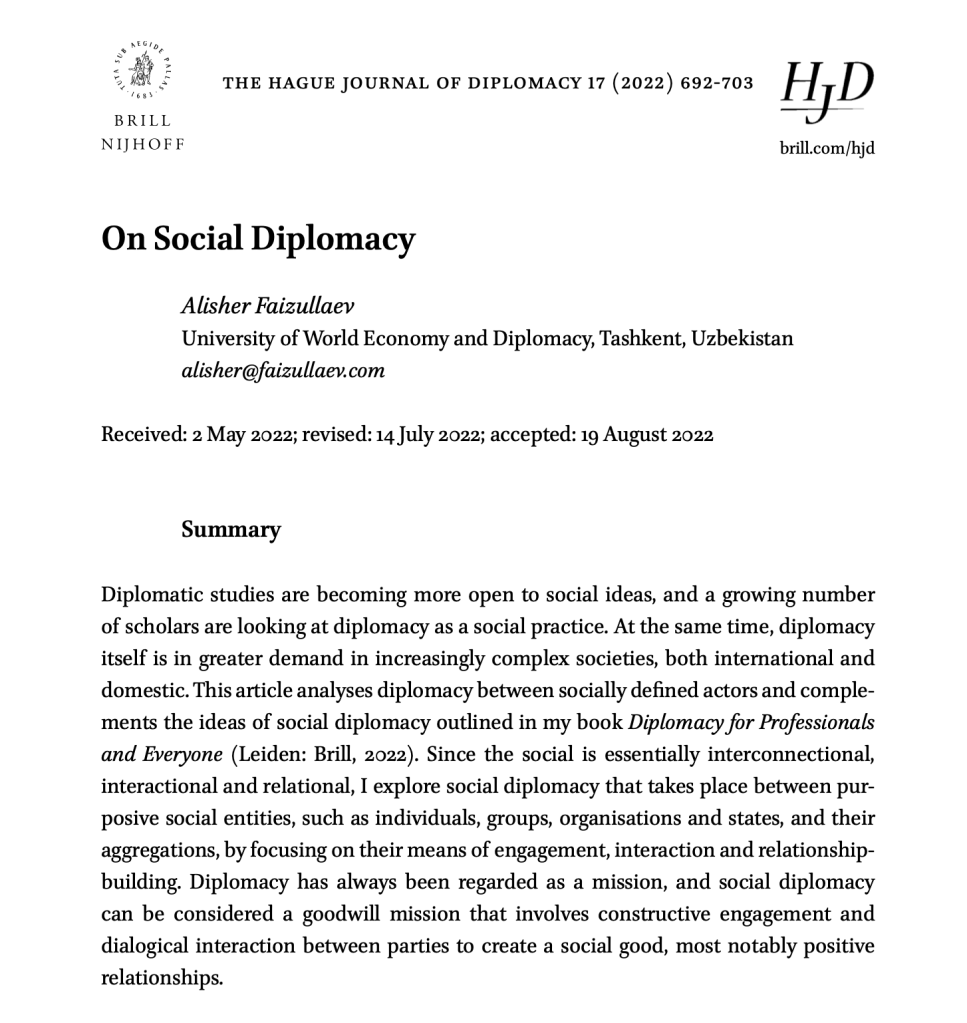
Today, as the world struggles with fragmentation and polarization, I was reminded of my 2022 article On Social Diplomacy in The Hague Journal of Diplomacy.

There I argued that diplomacy is not only the business of states. Civil society, cities, universities, communities – all can act as social diplomats. Their mission is not just conflict resolution, but the creation of goodwill and constructive relationships as a social good.

Three years later, this idea feels even more urgent. How can we broaden our understanding of diplomacy to include social actors? What new forms of dialogue and engagement are needed today?