Savoir-Faire: More Than Good Manners

The French expression savoir-faire is widely used but rarely examined. It is commonly translated as “knowing how to behave” or associated with good manners, elegance, social confidence, and polished conduct. While these qualities may reflect savoir-faire, they do not explain what it actually is.

At its core, savoir-faire is not about manners but about intelligence. More precisely, it is a form of practical intelligence exercised in social interaction. It is the ability to perceive a situation accurately, understand the people involved, adapt to changing circumstances, and act appropriately—often without relying on predetermined rules.

Most professional situations are not governed by manuals. Negotiations take unexpected turns. Meetings reveal hidden tensions. Relationships evolve. New opportunities emerge while others disappear. In such circumstances, success depends less on following procedures than on interpreting the situation correctly and responding with sound judgement.

Savoir-faire therefore begins not with behaviour but with perception. Before acting effectively, one must first understand what kind of situation one is facing. Who influences whom? What are the unspoken expectations? What matters to the participants? What is the appropriate degree of openness, firmness, patience, or flexibility? These questions are rarely answered explicitly, yet they shape every important interaction.

This understanding must then be translated into action. Here, adaptation and improvisation become essential. People with savoir-faire do not simply react to events; they adjust intelligently as situations unfold. They recognise opportunities where others see only obstacles, remain composed under uncertainty, and modify their approach without losing sight of their objectives.

In this sense, savoir-faire brings together several interrelated capacities: social perception, situational judgement, adaptive social intelligence, and skilful improvisation. These capacities are difficult to separate in practice. Together, they enable individuals to navigate complexity with confidence and effectiveness.

For diplomats, savoir-faire is not an optional refinement but a professional necessity. Diplomacy takes place in an environment characterised by cultural diversity, conflicting interests, ambiguity, and constant change. Diplomatic protocol provides an important framework, but protocol alone cannot resolve unforeseen situations. Communication techniques are useful, but they cannot determine when to speak, when to remain silent, when to compromise, or when to stand firm. Such decisions depend on judgement informed by savoir-faire.

The importance of savoir-faire, however, extends far beyond diplomacy. Negotiators, business leaders, physicians, lawyers, teachers, entrepreneurs, and public officials all operate in situations that require continuous interpretation and adaptation. Technical expertise may explain what should be done in principle. Savoir-faire determines how it can be accomplished successfully in practice.

Perhaps this also explains why savoir-faire is so difficult to teach. It cannot be acquired simply by learning rules or techniques. It develops through experience, observation, reflection, and repeated engagement with real situations. It grows as individuals learn not merely to apply knowledge but to understand contexts and respond intelligently to them.

In an age increasingly shaped by artificial intelligence and automation, savoir-faire reminds us that some of the most valuable human capabilities remain deeply situational. Information may be abundant, and analytical tools increasingly powerful, but the ability to understand people, exercise judgement, adapt creatively, and navigate complexity remains a distinctly human form of intelligence.

#savoir-faire #diplomacy #resourcefulness #SocialSkills

A Framework for Reflecting on Individual Diplomatic Representation

What makes an effective diplomatic representative? We often praise diplomats as “good” or “effective,” but effective in what sense? I have been developing a simple framework for reflecting on two dimensions of individual diplomatic representation: presentability and representability. The framework is intended to help analyse diplomats more systematically and to support diplomatic education, training and professional development.

Here is an early version of such a framework that can be tested in a classroom or training setting.

A FRAMEWORK FOR REFLECTING ON INDIVIDUAL DIPLOMATIC REPRESENTATION

Presentability is a diplomat’s capacity for effective social performance. It concerns how diplomats present themselves through their appearance, behaviour and interaction. It shapes first impressions, accessibility and influence.

Choose a diplomat (historical or contemporary) and reflect on the following dimensions:

□ 1 Poor
Creates negative impressions; appearance or behaviour undermines diplomatic effectiveness.

□ 2 Fair
Generally appropriate but often awkward, inconsistent or ineffective.

□ 3 Good
Professional, culturally appropriate and able to establish constructive relationships.

□ 4 Very Good
Projects confidence, adapts well across cultures and communicates persuasively.

□ 5 Outstanding
Creates exceptional trust, respect and positive engagement across diverse audiences.

Representabilityis a diplomat’s recognized capacity to represent the country credibly and effectively. It combines competence, credibility, judgement and the authority associated with the representative role.

Choose a diplomat (historical or contemporary) and reflect on the following dimensions:

□ 1 Poor
Lacks competence, credibility or authority.

□ 2 Fair
Has basic competence but limited influence or credibility.

□ 3 Good
Competent and generally trusted to represent national interests.

□ 4 Very Good
Exercises sound judgement and significant diplomatic influence.

□ 5 Outstanding
Represents the country with exceptional authority, credibility and strategic effectiveness.

Presentability concerns the social dimension of diplomacy — how diplomats appear, behave and interact with others. Representability concerns the strategic dimension of diplomacy — how diplomats think, judge and advance their country’s interests. Although the two are closely intertwined in practice, representability ultimately underpins durable diplomatic effectiveness, while presentability shapes access, trust and influence.

The practical refinement of presentability is smoothness — the capacity to conduct social interaction with ease, tact and influence. The practical refinement of representability is smartness — the capacity to exercise strategic judgement with competence, credibility and authority.

How could this framework be improved? Would you find it useful in diplomatic academies, foreign ministries or executive education?

For further reading: Faizullaev, Alisher. (2026). “Presentability and Representability: Rethinking Individual Diplomatic Representation”, The Hague Journal of Diplomacy (advance publication). DOI: https://doi.org/10.1163/1871191X-bja10232

#diplomacy #diplomat #presentability #representability #smoothness #smartness #representation

At the European Negotiation Conference, Paris

Just returned from the European Negotiation Conference in Paris. It was encouraging to see how negotiation is continuing to grow as a distinctive field of both scholarship and professional practice. The conference brought together researchers, practitioners, consultants, coaches, diplomats, business professionals, and AI experts from many countries — a reflection of the field’s increasing diversity and vitality.

I was especially struck by the growing number of executive education and practice-oriented workshops. As organizations face more complex and uncertain environments, the demand for advanced negotiation capabilities is clearly increasing.

Many discussions also touched on the fragility of the current world order and on how negotiation, despite all its limitations, can help move us toward greater mutual understanding and peace. Artificial intelligence was another major theme throughout the conference.

I was pleased to present my paper, “Overt and Embedded Bargaining Systems: Bargaining Infrastructure and the Organization of Reciprocal Adjustment,” and to exchange ideas with colleagues from around the world.

The conference left me optimistic. Negotiation studies are becoming an increasingly vibrant interdisciplinary community, and I look forward to seeing where the field goes next.


hashtag#Negotiation hashtag#Leadership hashtag#Diplomacy hashtag#ConflictResolution hashtag#AI hashtag#Research hashtag#ExecutiveEducation hashtag#WorldOrder

Why Infrastructure Matters

Watching major football tournaments has made me think about something that extends far beyond sport. At the highest level, success is rarely produced by individual talent alone. It depends on infrastructure.

A world-class football team requires youth academies, experienced coaches, strong domestic leagues, sports science, financial resources, international exposure, and regular competition against elite opponents. The same is true in academia.

World-class research depends on much more than brilliant scholars. It requires libraries, seminars, conferences, research funding, doctoral training, international networks, rigorous criticism, access to journals, and institutions that make excellence routine rather than exceptional.

Of course, exceptional individuals sometimes emerge despite weak infrastructures. History offers many examples. Yet sustained excellence—whether in sport, science, or the arts—is rarely achieved in this way.

There is, however, an important nuance. Infrastructure does not have to be domestic. Many outstanding footballers come from countries with relatively weak football systems but reach their full potential after entering the academies and clubs of Europe’s leading leagues. The same is true in academia. Talented researchers may begin their careers in modest universities yet flourish after joining stronger international research environments. What matters is not only where talent originates, but whether there are pathways connecting talent to infrastructures capable of developing and recognizing it.

Infrastructure also performs another, less discussed function. It does not merely produce excellence; it regulates access to excellence. Strong infrastructures cultivate talent, but they also influence who is admitted, trusted, recognized, funded, and given opportunities to grow.

Perhaps this offers another perspective on the long-standing structure–agency debate. Agency helps explain exceptional individuals. Infrastructure helps explain why exceptional individuals emerge repeatedly in some environments and only rarely in others.

Presentability and Representability: Rethinking Individual Diplomatic Representation

I’m pleased to share that my article “Presentability and Representability: Rethinking Individual Diplomatic Representation” has been published online in the Hague Journal of Diplomacy. I’m grateful to colleagues, editors, and reviewers whose thoughtful feedback helped improve the paper. The full article is available here:

https://brill.com/view/journals/hjd/aop/article-10.1163-1871191X-bja10232/article-10.1163-1871191X-bja10232.xml

Spirit of UWED Award

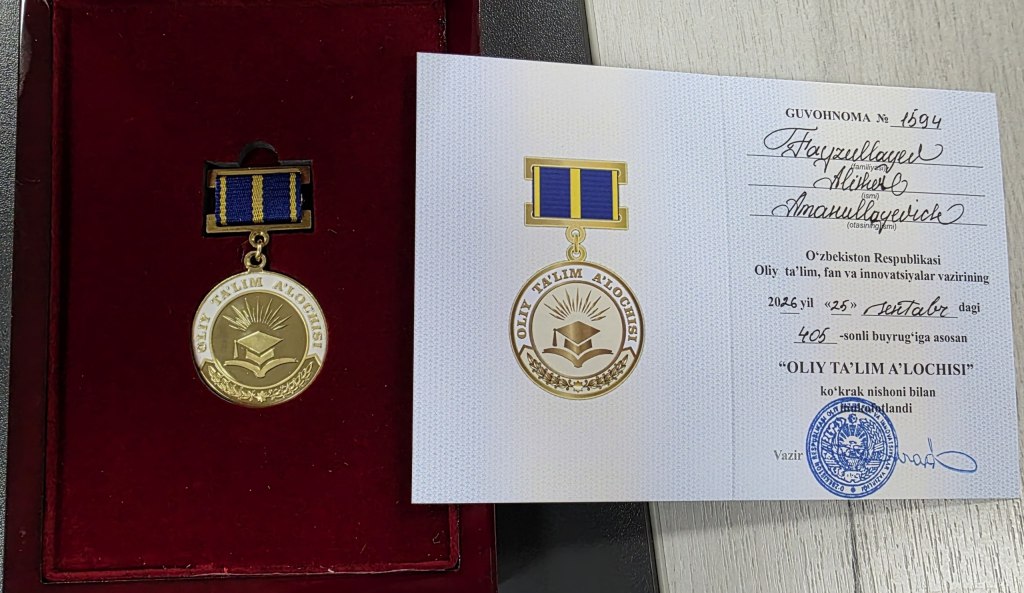
I am deeply grateful to my university, the University of World Economy and Diplomacy, and personally to Rector – Senator Sodyq Solikhovich Safoev for the Spirit of UWED Award.

It is a great honor to teach at UWED, one of the leading universities in Central Asia, and to work with such talented students and colleagues.

As a Power with a Power: The Politics of Interpersonal Relations

More than a decade ago, I published a book in Russian titled As a Power with a Power: The Politics of Interpersonal Relations.

It was not a book about grand strategy or formal authority. It was about where power most persistently lives – in everyday interactions: in offices and families, in negotiations and silences,
in status cues, symbols, routines, and unspoken rules.

The book grew out of lived experience and an attempt to understand power more honestly – its mechanics, its seductions, its limits, and its ordinary, often invisible forms.

Today, I find myself thinking about power in a slightly different register – in relation to thought.

Confucius and Machiavelli both sought political office. Both wanted to operate inside power. Yet their lasting influence came not from the positions they held, but from the ideas they were compelled to articulate when power remained out of reach.

Power attracts, even reflective minds. It offers immediacy, visibility, and a sense of significance here and now.

And yet: power makes a person significant in life, thought – even after.

#power #thought

Character Attack and Reputation Management in Diplomacy

A new conversation on my Diplomatic Nexus channel.

Together with Professor Eric Shiraev, we examine character attack as a strategic tool in diplomacy and the problem of reputation management under political pressure.

Character attack is not simply a personal insult or rhetorical excess. It is a method of influence that can delegitimize actors, reshape negotiations, and alter diplomatic outcomes. Despite its growing relevance, this phenomenon remains surprisingly underexplored in mainstream diplomatic studies.

Professor Eric Shiraev (George Mason University) is a leading scholar on character assassination and reputation dynamics, and the author of more than thirty books on political psychology, leadership, and influence.

The conversation is relevant for diplomats, analysts, and anyone interested in how power operates beyond formal negotiations.

‪@DiplomaticNexus‬

Subscribe and like.

#diplomacy #characterassassination #reputation

The Train to Kyoto

It happened in Japan, at one of Tokyo’s train stations. My friend and I were waiting for the train to Kyoto. A woman’s voice announced arrivals and departures, but I understood nothing in Japanese. I noticed my friend kept glancing at his watch. I asked:

“Is something wrong?”

“No.”

But it seemed to me he was hiding something.

“Is the train late?” I continued asking.

“Oh, if only!” he answered, looking at his watch again.

“What do you mean?” I was surprised. “You don’t want it to be late, do you?”

“No, quite the opposite.”

I didn’t understand anything.

“You see, if the train is late, the company has to pay us compensation. It would be nice to earn a little extra.”

“And that’s why you keep looking at your watch?”

“Yes, judging by the announcement, there’s a chance the train might be delayed. So I got my hopes up a little… But to tell the truth, I’ve never had a case in my life where a train was late.”

“Let me also pray mentally for it to be late,” I said and closed my eyes.

While we stood on the platform praying, the train safely (and, to our regret, on time) arrived. My friend looked at me guiltily and shrugged. With a deep sigh, we boarded the train and departed for Kyoto. But then a secret hope arose in me.

Maybe we’d be delayed en route and arrive late to the ancient capital of Japan? Alas, this hope didn’t come true either. Moreover, our return train also arrived in Tokyo on schedule.

Well, what can you do? There are times when even prayers don’t help.

First published on my Substack: https://alisherfaizullaev.substack.com/p/the-train-to-kyoto

#Train #Japan #Delay #Pray