My conversation with Dr. Vincent Pouliot:
Category: Uncategorized
The Art of Communication

The art of #communication is important. Especially if a person has something to say, or has nothing to say
The Myth of Talent

Throughout my fairly long life, I may have met one or two truly talented people (and even then, I’m not entirely sure). There are, of course, more capable individuals. But ability, unlike talent, is not necessarily an inborn trait—it can also be the result of effort, experience, and discipline. Talent, on the other hand, is something natural, innate, independent of effort. You either have it, or you don’t.
I believe that much of the talk about talent is heavily mythologized. Truly talented people are extremely rare (and geniuses are even rarer). The vast majority of successful individuals achieve their status not due to some inherent gift but primarily through hard work, perseverance, and, to some extent, luck.
So, talent may not be entirely a bad thing, but you’ll still have to work. And work damn hard if you want to achieve anything on this planet (ah, motivation, motivation!). A bit less if you have abilities, but even they don’t mean much on their own—you need to know how to apply, develop, and even retain them; otherwise, they quickly fade away. In short, if there’s no talent, there’s always hard work and sweat.
By the way, this is something to be glad about: if your success is based entirely—or even mostly—on talent, then there’s little personal merit in it. After all, talent is given to you from the outside, and you possess it not because of your own efforts or achievements. There’s little sense in relying on a gift that was handed to you by chance.
Master of Detail

Being a master of detail is one of the most challenging skills. Especially in social life.
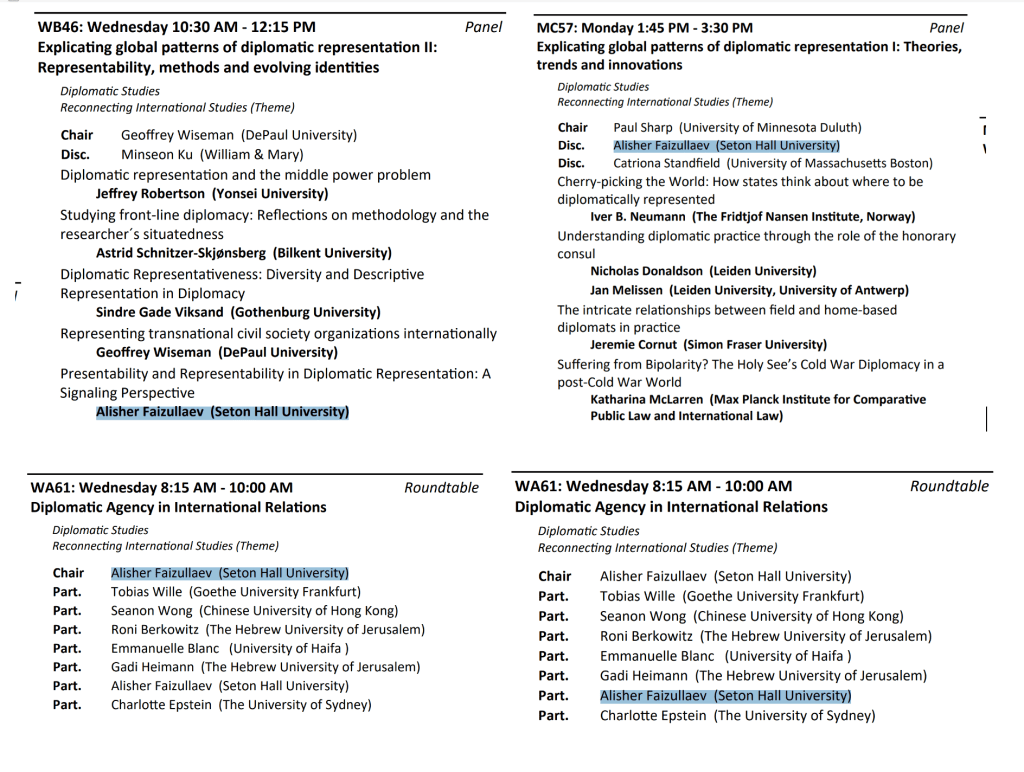
AT ISA2025
Just finished my participation at the International Studies Association Annual Convention in Chicago with a souvenir photo.

Dr. Jozef Bátora: How Powerful is the EU? The Reality of European Diplomacy
A new video on the Diplomatic Nexus YouTube channel: my conversation with Dr. Jozef Bátora about the European Union’s diplomacy, the organization and the functioning of the EU diplomatic service. Dr. Bátora is a Professor of International Relations at Webster Vienna Private University in Vienna and at the Department of Political Science, Comenius University in Bratislava. He was also a senior researcher at ARENA Centre for European Studies, University of Oslo, researcher at the Austrian Academy of Sciences in Vienna, and visiting scholar and visiting professor at Stanford University.
I recommend it to anyone interested in the EU and European diplomacy.
Education and Character

Education is important but character is no less important.
“Professional” in American Culture

In America, I have repeatedly noticed how the word “professional” is perceived. First, it is used very broadly, encompassing an entire class of occupations such as doctors, lawyers, business consultants, teachers, professors, and other white-collar workers. Of course, you might hear phrases like “professional boxer” or “professional dancer,” but in most cases, the term “professional” refers to people engaged in intellectual activities and working within certain standards.
Second, professionalism is closely linked to specific behavior and appearance. To “look and act professionally” means dressing neatly, conservatively, and formally, as well as demonstrating politeness, attentiveness, and proper speech while avoiding slang or informal expressions. Writing professionally is also an important aspect, particularly in emails, where clarity, proper formatting, and polite, concise language are expected norms.
Third, telling someone that they look or act professionally is indeed high praise. Such a remark pertains not only to appearance but also to the overall impression a person makes: neatness, reliability, respect for others, and adherence to expectations—all these are associated with professionalism in American culture.
This approach to professionalism stands out when compared to other cultures, where the emphasis might be more on experience or expertise rather than appearance or behavioral aspects. In the U.S., professionalism is not only about skills but also about the ability to meet high standards of self-presentation.
At Seton Hall University
I am happy to be this Spring semester at the School of Diplomacy and International Relations, Seton Hall University, New Jersey, as a Visiting Scholar/Professor of Practice. Great university, wonderful school – one of the best in the world.
In the photo: First day in my new office.

Diplomacy at Critical Junctures – A New Video on “Diplomatic Nexus” Channel
New video on my “Diplomatic Nexus” YouTube channel: A conversation with a young but already known scholar in the field of international relations and diplomacy Seanon Wong. Dr. Wong is an Associate Professor and the Head of the Undergraduate Program in Government and Public Administration, and the Director of the International Affairs Research Centre, the Institute of Asia-Pacific Studies, the Chinese University of Hong Kong. He is also an Executive Editor of the International Relations of the Asia-Pacific journal, Area Editor of the Oxford Bibliographies (International Relations), and a Member of the International Editorial Board of The Hague Journal of Diplomacy.
In the conversation, Professor Wong and I discussed the features of modern diplomacy and diplomatic studies, the role of individuals, body language, intentions and intercultural differences in diplomacy, relations between IR and diplomatic studies, as well as other issues related to understanding diplomatic theory and practice.
 Alisher Faizullaev