There is an Uzbek saying: “Your father is the bazaar, your mother is the bazaar.” That is a foundational insight to our #bargaining culture. Bazaars are more than commercial spaces, and bargaining becomes about establishing connection, mutual respect, and fairness.
Working or not?
If looking for work is your work, are you working or out of work?
Optimal Motivation

Often it is motivation, rather than brain, knowledge, experience, abilities, or skills, that determines a person’s fate and defines their success or failure in endeavors. Motivation is like blood in the body, or air in the lungs. But even it must be optimal—neither too weak nor excessive. Like everything else in life. Optimal motivation is like a fire in a fireplace—strong enough to warm and illuminate the path, but controlled so as not to burn down the house. It provides energy to move forward while preserving the ability to reflect and adjust course.
Point and Circle: A Philosophical Reflection

Point and Circle: A Philosophical Reflection
The point and the circle represent some of the most ancient and fundamental symbols. Both are closed objects. But if the point is a “thing in itself,” then the circle can prove to be universal. The point, expanding, becomes a circle, and the circle, contracting, transforms into a point.
The point, properly speaking, is an abstraction, since it has no parameters of magnitude. But without volume, without area, and without length, it fills all volumes, areas, and lengths. In other words, being nothing, the point creates all objects existing in the world. The point is the material of creation, the fabric of all forms. The number of points would express the largest number in the universe. But the universe itself is also a kind of point in some super-universe.
If, expanding, each point is capable of becoming a circle, this means that potentially the number of points and circles can be equal. At the same time, each circle consists of an infinite number of points, which, in turn, can transform into circles.
But not every point is destined to become a circle: a circle has neither end nor beginning. A circle begins and does not begin with a point. Being woven from points, it is also independent of them.
The point and circle are whole and harmonious. The point has hidden harmony, the circle has open harmony. But the circle is not an open object, therefore it can prove to be not only sacred or magical, but also vicious. Everything depends on the points that form the circle.
Every human being is a point in the universe, but each human being has their own circles.
Theory vs. Practice: The Paradox of Professional Knowledge

Theory vs. Practice: The Paradox of Professional Knowledge
Negotiation
Many outstanding negotiators in business, diplomacy, and politics have never read negotiation books or attended training sessions. Yet they excel at what they do.
Their effectiveness comes from completely different sources: deep understanding of human psychology, the ability to read situations and instantly adapt, an intuitive sense of timing and context, and years of accumulated experience, including mistakes.
Meanwhile, theorists try to break down this living art into schemes, models, and step-by-step algorithms. It’s like trying to teach someone to dance by studying an anatomy textbook.
International Relations
The gap between theory and practice is even more noticeable in the field of international relations. A large portion of academic literature in IR has little to offer to actual practitioners, even those who would like to learn from it.
A diplomat who has spent decades working in real-world diplomacy knows more about decision-making mechanisms than any theoretical model can describe. They understand that decisions are made by people – with their ambitions, fears, and personal relationships – not by merely abstract entities called “states” pursuing more or less stable national interests. True masters of practice create their own “theories” on the fly, adapting to the uniqueness of each situation.
But Theory Still Matters
Even so, theories and theorists play an important role. They help structure the thinking of beginners and provide basic frameworks for understanding complex processes. They create a shared language that allows practitioners from different fields to exchange experiences. They systematize knowledge and make it transferable to future generations. They raise new questions and push practitioners to reflect on their actions. They also provide academic legitimacy for training and education.
As some physicists have said, “There is nothing more practical than a good theory.”
Hopefully, someday we’ll be able to say the same about negotiation and international relations.
A Point of No Return
Every point is a point of no return. Is it worth looking back?
Tai Chi and Chinese Negotiation Behavior: My New Chapter
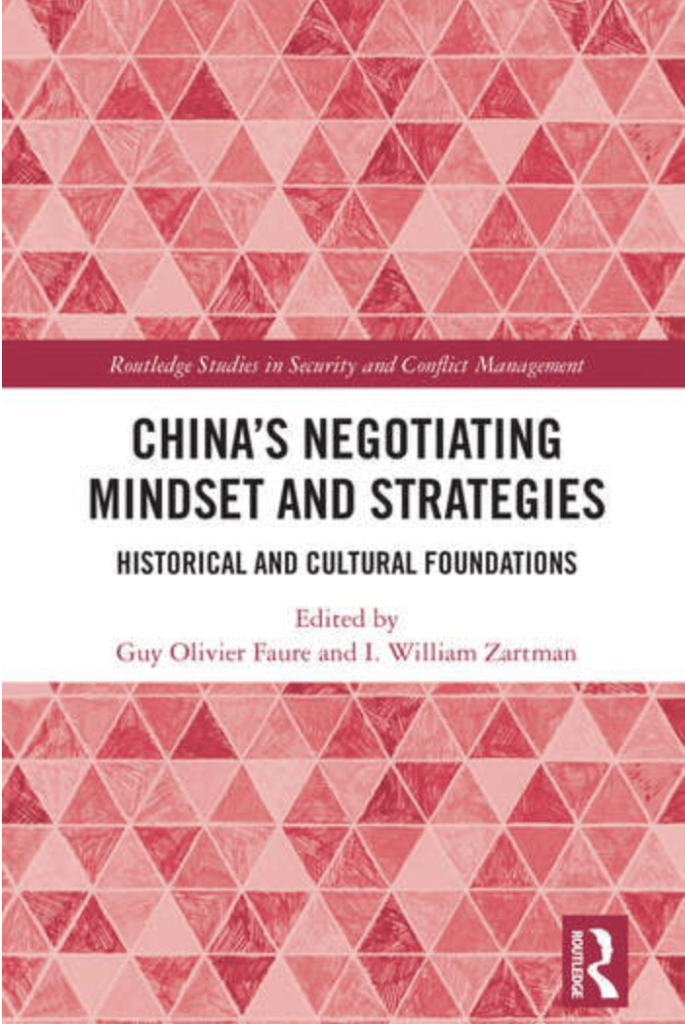
The publication of an author’s work is always a big and exciting event for him or her. But there are publications that an author awaits especially eagerly. Today I received just such a publication in the mail: the book “China’s Negotiating Mindset and Strategies: Historical and Cultural Foundations” edited by renowned scholars Guy Olivier Faure and I. William Zartman (London and New York: Routledge, 2025). The book also contains a chapter written by me, “Tai Chi and Chinese Negotiation Behavior” (pp. 69-82), of which I am quite proud.
This chapter is the result of my many years of practice and reflection. I want to sincerely thank Professors Olivier Faure and William Zartman for the invitation to contribute to this important book.


Tai Chi and Chinese Negotiation Behavior
Excited to announce my contribution to an upcoming scholarly publication!
I’m honored to have authored a chapter titled “Tai Chi and Chinese Negotiation Behavior” in the forthcoming book “China’s Negotiating Mindset and Strategies: Historical and Cultural Foundations,” edited by Guy Olivier Faure and I. William Zartman, published by Routledge.
My chapter explores the fascinating intersection between ancient Tai Chi principles and modern Chinese negotiation practices, examining how traditional philosophical concepts continue to influence contemporary negotiations.
Understanding cultural foundations is crucial for effective cross-cultural negotiation, and I’m thrilled to contribute to this important academic discourse on Chinese negotiating strategies.
Looking forward to sharing more insights when the book is released!
The UN at a Crossroads: What Must Change?
New video on my Diplomatic Nexus channel:
A compelling conversation with Ambassador Farrukh Khan – a seasoned diplomat with extensive UN experience. We explore the challenges and pressing reforms facing the United Nations, what it means to work within the UN system, and the evolving landscape of multilateral diplomacy.
Welcome to your brain’s language party!
Picture this:
Your brain is throwing a secret party. The guests are languages from different continents, each dressed and styled in their own unique way. After a ceremonial bow, each one takes its cozy corner in your head, curiously eyeing the DJ who’s warming up. The Eastern beauties—Chinese, Japanese, and Korean—are true artists: vivid and imaginative. Naturally, this creative crowd prefers to hang out in the right hemisphere of the brain, where expressiveness and fantasy reign supreme.
And your brain is totally vibing, floating off somewhere. Pure bliss. Learning a bunch of different languages isn’t just a fun party—it’s a real workout too. Sure, it takes a decent chunk of time (oh well… no, oh my!), but your brain transforms into a genuine superhero with incredible abilities. This superbrain can not only dance and sing folk songs from around the world, but also run fast and jump high like an athlete.
A child’s brain isn’t just a galaxy—it’s the cosmos!
Children’s brains are a whole different story! They’re like superhero sponges that soak up languages easier than we gulp down our morning coffee. A kid growing up in a multilingual family doesn’t even bat an eye at the fact that Dad speaks one language, Mom speaks another, and Grandma speaks a third or even a fifth language. And grandpa might just stay silent in some special language of his own, sparing the world from the uncertainty of his thoughts.
A child’s brain is pure white magic! It juggles grammar and vocabulary like a circus performer, never gets tangled up between languages, and somehow manages to stay incredibly flexible. For children, learning languages isn’t stressful—it’s an adventure! The main things for them are chatting with their parents, exploring the world, and having fun while doing it. And playing while they’re at it. Languages? Pfft, that’s so easy when you’re a bright wizard!
What does the AI era whisper?
However, here emerges an intriguing puzzle of our time. On one hand, artificial intelligence translates faster than lightning and seems poised to send translators into retirement soon. Some even whisper, as if afraid that some Alexa might overhear from around the corner: “Why bother learning languages at all if AI does it better than us?”
And Alexa listens, taking mental notes. But for now, she only speaks when asked. Meanwhile, she’s probably thinking: “But wait a minute! Maybe it’s not just about translation? When your brain throws that language party, it doesn’t just translate words—it thinks differently, feels anew, sees the world through a different lens!”
So we get a dilemma worthy of Sherlock Holmes: trust languages to smart machines or keep training our sometimes lazy brains? Who knows, who knows? Personally, I have absolutely no idea.
 Alisher Faizullaev