Books vs Short Videos


These days, fewer people turn to long books. Short videos and quick social posts have taken their place. The experiences are not the same: a book is like a long dinner, while a clip is more like a quick bite. Both can be satisfying in their own way – one offers depth, the other immediacy.

A book asks more of us. It trains the mind to carry complexity, calls on the imagination in full, and demands attention that cannot be faked. In contrast, short videos flow past with little resistance; concentration is optional, sometimes even unwelcome.

Reading also slows the rhythm of life. It asks us to pause and think. By comparison, reels and shorts push us along, one after another, often before we have even finished the last.

Short forms have their charm. But when everything we take in is digested in seconds, our thinking risks becoming just as brief. A book, by contrast, cultivates resistance—to haste, to surface impressions, to easy answers. Without that resistance, thought itself becomes shallow.
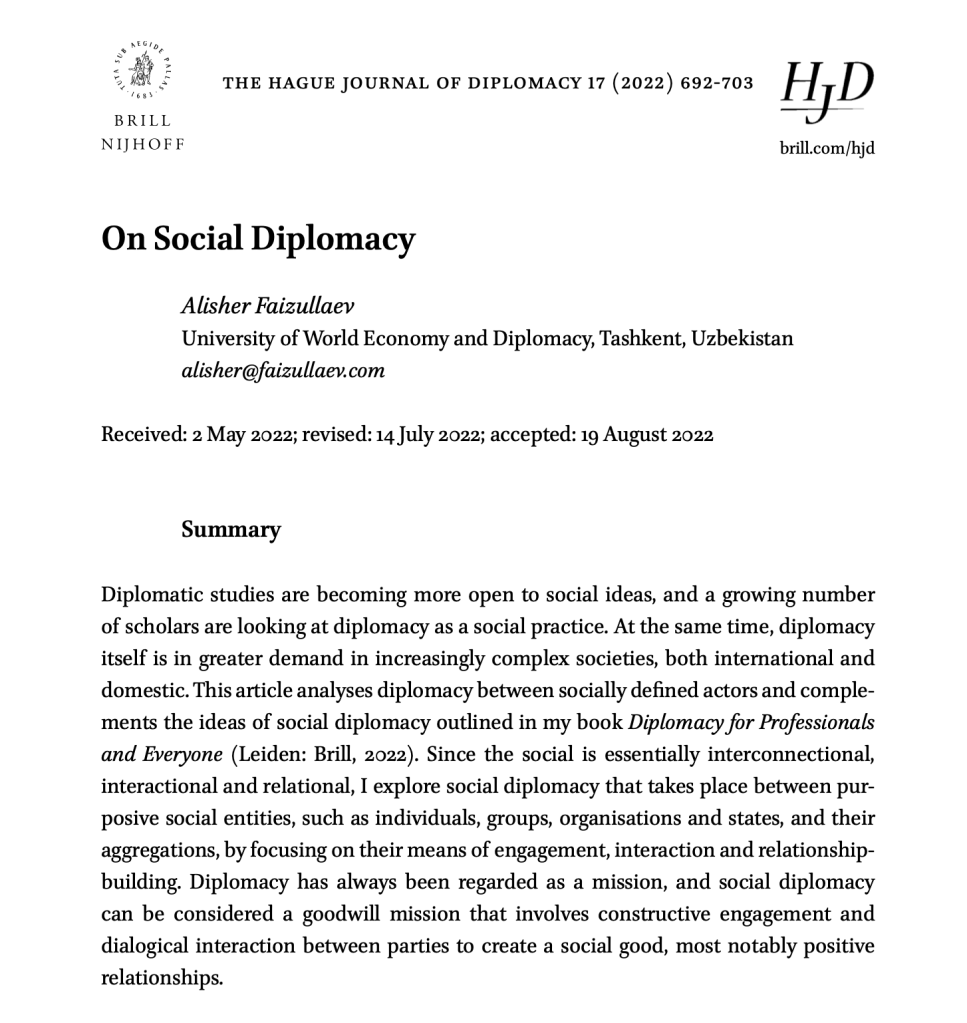

About Social Diplomacy

Today, as the world struggles with fragmentation and polarization, I was reminded of my 2022 article On Social Diplomacy in The Hague Journal of Diplomacy.

There I argued that diplomacy is not only the business of states. Civil society, cities, universities, communities – all can act as social diplomats. Their mission is not just conflict resolution, but the creation of goodwill and constructive relationships as a social good.

Three years later, this idea feels even more urgent. How can we broaden our understanding of diplomacy to include social actors? What new forms of dialogue and engagement are needed today?

Strategic Thinking in Action

Yesterday, I was honored to conduct a “Strategic Thinking in Action” workshop for participants of the Young Professional Internships Program (YPIP) at American Councils for International Education in Tashkent.

The session covered practical frameworks for strategic analysis, decision-making processes, and interaction. Participants demonstrated strong engagement through active discussions and interactive games. Well done.

#StrategicThinking #ProfessionalDevelopment #YPIP #AmericanCouncils #Tashkent #Leadership #Mentoring #Uzbekistan #YoungProfessionals

Teaching

Excited to teach this fall semester at two leading universities in Uzbekistan: “Strategic Thinking and Interaction” at the University of World Economy and Diplomacy (UWED) and “Issues in International Relations – Negotiation and Persuasion” at Webster University in Tashkent (WUT).

I hope that students will gain not only important theoretical knowledge, but also useful practical skills.

#InternationalRelations #Negotiation #Persuasion #StrategicThinking #Uzbekistan #Academia #Teaching

Optimal Motivation

Often it is motivation, rather than brain, knowledge, experience, abilities, or skills, that determines a person’s fate and defines their success or failure in endeavors. Motivation is like blood in the body, or air in the lungs. But even it must be optimal—neither too weak nor excessive. Like everything else in life. Optimal motivation is like a fire in a fireplace—strong enough to warm and illuminate the path, but controlled so as not to burn down the house. It provides energy to move forward while preserving the ability to reflect and adjust course.

Point and Circle: A Philosophical Reflection

Point and Circle: A Philosophical Reflection

The point and the circle represent some of the most ancient and fundamental symbols. Both are closed objects. But if the point is a “thing in itself,” then the circle can prove to be universal. The point, expanding, becomes a circle, and the circle, contracting, transforms into a point.

The point, properly speaking, is an abstraction, since it has no parameters of magnitude. But without volume, without area, and without length, it fills all volumes, areas, and lengths. In other words, being nothing, the point creates all objects existing in the world. The point is the material of creation, the fabric of all forms. The number of points would express the largest number in the universe. But the universe itself is also a kind of point in some super-universe.

If, expanding, each point is capable of becoming a circle, this means that potentially the number of points and circles can be equal. At the same time, each circle consists of an infinite number of points, which, in turn, can transform into circles.

But not every point is destined to become a circle: a circle has neither end nor beginning. A circle begins and does not begin with a point. Being woven from points, it is also independent of them.

The point and circle are whole and harmonious. The point has hidden harmony, the circle has open harmony. But the circle is not an open object, therefore it can prove to be not only sacred or magical, but also vicious. Everything depends on the points that form the circle.

Every human being is a point in the universe, but each human being has their own circles.

Theory vs. Practice: The Paradox of Professional Knowledge

Theory vs. Practice: The Paradox of Professional Knowledge

Negotiation

Many outstanding negotiators in business, diplomacy, and politics have never read negotiation books or attended training sessions. Yet they excel at what they do.

Their effectiveness comes from completely different sources: deep understanding of human psychology, the ability to read situations and instantly adapt, an intuitive sense of timing and context, and years of accumulated experience, including mistakes.

Meanwhile, theorists try to break down this living art into schemes, models, and step-by-step algorithms. It’s like trying to teach someone to dance by studying an anatomy textbook.

International Relations

The gap between theory and practice is even more noticeable in the field of international relations. A large portion of academic literature in IR has little to offer to actual practitioners, even those who would like to learn from it.

A diplomat who has spent decades working in real-world diplomacy knows more about decision-making mechanisms than any theoretical model can describe. They understand that decisions are made by people – with their ambitions, fears, and personal relationships – not by merely abstract entities called “states” pursuing more or less stable national interests. True masters of practice create their own “theories” on the fly, adapting to the uniqueness of each situation.

But Theory Still Matters

Even so, theories and theorists play an important role. They help structure the thinking of beginners and provide basic frameworks for understanding complex processes. They create a shared language that allows practitioners from different fields to exchange experiences. They systematize knowledge and make it transferable to future generations. They raise new questions and push practitioners to reflect on their actions. They also provide academic legitimacy for training and education.

As some physicists have said, “There is nothing more practical than a good theory.”

Hopefully, someday we’ll be able to say the same about negotiation and international relations.