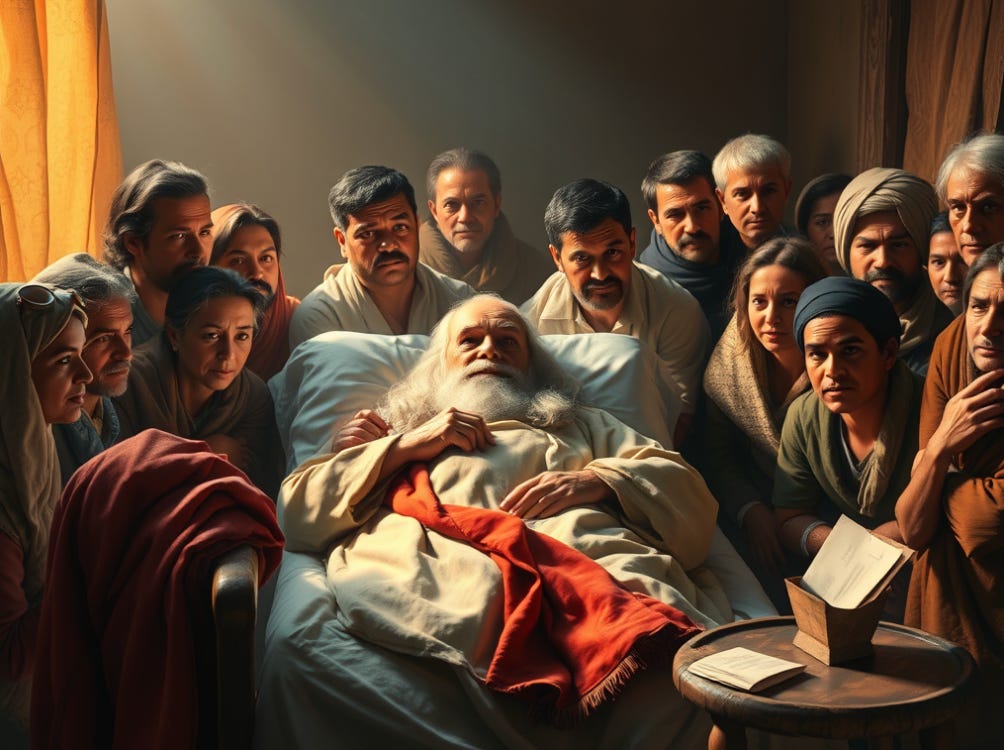
There once lived a village sage who mostly kept silent. The villagers expected revelations from him, but he never hurried. Years passed, the sage grew very old, yet he still made no move to enlighten anyone. By the end of his life, he stopped speaking altogether.
When the moment came and he felt he was leaving this world, many people gathered around him. Even visitors from neighboring villages arrived. Everyone hoped that before dying he might finally say something truly important.
Indeed, right before his final breath, the old man looked around and slightly opened his mouth. The crowd fell silent.
The emerging 28-points peace initiative functions as a public version of a Single Negotiating Text (SNT), a mediation technique. One of the most consequential applications of this method took place at Camp David in 1978, when U.S. President Jimmy Carter mediated between Egyptian President Anwar Sadat and Israeli Prime Minister Menachem Begin.
In any SNT process, placing a structured framework on the table in advance means the mediator is not merely facilitating discussion but shaping and largely controlling the negotiation space before the parties even sit down. That is the central strength of the SNT approach.
At Camp David, Carter used a confidential SNT and continually refined it through 23 iterations until agreement became possible. A related logic appeared in the 1982–83 “Walk in the Woods” episode, where U.S. negotiator Paul Nitze and Soviet negotiator Yuli Kvitsinsky stepped outside rigid formal positions on nuclear negotiations to craft an intermediate proposal that neither side could publicly initiate but both could evaluate.
The difference now is the public nature of the text. Once an SNT becomes visible, every actor evaluates it through domestic pressures and strategic narratives. Even so, the architecture matters. Although the distribution of incentives in the text appears uneven, the 28-points framework introduces linkages and options that neither side could realistically table publicly. What follows remains to be seen.
Business and diplomacy may seem to belong to different realms, yet both depend on the same essential craft: the ability to manage complex and high stakes negotiations in uncertainty and with competing interests. In diplomacy, careers and international stability can hinge on a single conversation or understated message. In business, billions of dollars and corporate reputations can turn on the outcome of a deal.
Having served as ambassador, negotiation scholar, and business trainer and consultant, I have witnessed how diplomatic principles – careful preparation, emotional discipline, social grace, and cultural intelligence – can give business leaders a decisive edge.
Where many corporate negotiations remain transactional and price-driven, diplomacy operates in fluid environments where subtle signaling, long-term positioning, and managing relationships often matter more than immediate tangible outcome. Leaders who adopt diplomatic skills can navigate these conditions with greater confidence and achieve agreements that endure.
Below are six diplomatic strategies that business leaders can adapt to strengthen their negotiation mastery.
1. Prepare Beyond the Numbers and Immediate Results
Seasoned diplomats never approach a negotiation without deep groundwork. They study every stakeholder, including hidden ones, anticipate reactions, align their internal teams, and map out alternative scenarios. Preparation extends far beyond compiling statistics, financial models, and immediate results. It involves uncovering motivations, concealed constraints, long-term thinking, and the informal networks that influence decision making.
For business leaders, this means asking the questions behind the spreadsheets: What drives each party’s behavior? Who holds quiet influence in the room? What future opportunities might be jeopardized by a short-term concession? A global merger, for example, may hinge less on price than on regulatory attitudes or political sensitivities.
Diplomatic approach balances urgent objectives with long-term relationships. A negotiator who protects future partnerships, rather than trading them away for a quick win, secures not only today’s deal but tomorrow’s access.
2. Project Strength with Courtesy
Power in diplomacy is not merely positional or related to hard power; it is behavioral and may come from soft power. Skilled diplomats maintain calm, respectful presence even when national interests collide. They regulate emotional tone, respond with tact, and build influence through steadiness rather than volume. Skilled diplomats blend outward courtesy with inner resolve.
Business leaders face similar high-pressure moments – boardroom showdowns, late-night crisis calls, tense cross-border emergencies and bargaining. In such settings, those who combine firmness with courtesy gain far more leverage than those who dominate the room. Emotional intelligence becomes a strategic asset: reading the atmosphere, paying attention to details, defusing tension, and signaling confidence without aggression.
Courtesy is not weakness. It is a deliberate form of strength that invites dialogue and keeps the door open for creative solutions when talks reach an impasse.
3. Communicate with Precision and Intent
Diplomatic communication is never accidental. Every word, pause, and gesture carries meaning. Timing can be as critical as content; a single well-placed silence can convey resolve more effectively than a paragraph of arguments.
Business negotiations demand the same discipline. Leaders must craft messages that are clear yet flexible, avoiding unnecessary detail while leaving space for movement. Non-verbal cues – tone, body language, seating arrangements – can reinforce or undermine stated intentions.
Consider a technology partnership where cultural norms differ sharply: a casual remark that seems harmless in one market might be interpreted as a binding promise in another. Diplomats are masters of communication. A diplomatic approach anticipates these sensitivities, ensuring that communication advances strategy rather than creating costly misunderstandings.
4. Preserve Dignity and Build Trust
Lasting agreements require more than handshakes and signatures. They demand that all parties feel respected throughout the process. Diplomatic negotiators go to great lengths to protect the dignity of their counterparts, offering face-saving options, sharing credit, and avoiding public cornering even when disagreements are deep.
In business, preserving dignity is equally powerful. A supplier who leaves the table feeling humiliated may retaliate later; an investor who feels respected will return for the next round. Trust is built through consistent actions, maintaining confidentiality, and carefully fulfilling promises. Trust building takes time and patience.
By safeguarding reputation – both their own and that of their counterparts – leaders create the psychological conditions for durable cooperation.
5. Cultivate Cultural Intelligence and Adaptability
Diplomats are students of culture. Before entering a negotiation, they learn the history, etiquette, and decision-making styles of their counterparts. This cultural intelligence provides a critical advantage in an interconnected economy where deals often cross borders and time zones.
For executives, cultural fluency can determine whether a partnership thrives or collapses. A gesture of warmth in one region may be seen as intrusive elsewhere. Decision cycles that are rapid in Silicon Valley may move deliberately in East Asia. Leaders who adapt their style, without abandoning core objectives, reduce friction and build credibility with diverse partners.
Flexibility is not compromise; rather, it represents strategic alignment. In diplomacy, it combines brilliantly with persistence. By adjusting methods to context while staying anchored to purpose, business negotiators can bridge gaps that purely transactional players cannot.
6. Practice Strategic Restraint
Perhaps the most counterintuitive diplomatic lesson is the power of restraint. Knowing when to speak, when to wait, and when to allow silence to work is often more effective than a barrage of arguments. Business negotiations frequently reward the same discipline. A well-timed pause can prompt concessions; a delayed response can signal careful consideration rather than weakness. Strategic restraint also prevents public escalation, protects relationships, and keeps attention on long-term outcomes rather than short-term point scoring. Quiet effectiveness often beats loud declarations. In diplomacy, it goes hand in hand with determination. The leader who resists the urge to react impulsively preserves room for creative solutions and protects the integrity of the process.
Leading Like a Diplomat
Today’s executives face global operations, public scrutiny, complex partnerships, and multicultural teams. Technical expertise and financial acumen are necessary but insufficient. Effective leadership requires the ability to negotiate in environments of uncertainty, shifting alliances, and cultural diversity.
By integrating these six diplomatic strategies – deep preparation, courteous strength, precise communication, trust building, cultural intelligence, and strategic restraint – business leaders can transform negotiations from zero-sum battles into collaborative problem-solving.
The result is not merely better deals. It is stronger teams, deeper partnerships, and a leadership style capable of navigating the volatile, interconnected world of twenty-first-century commerce.
After much thought, Thornton Zhu came to realize that everything in the world is connected to everything else. Gradually he began to sense those connections – between the falling leaves in London’s Holland Park and a volcanic eruption in Kamchatka, between his wife’s moods and the rising level of the world’s oceans.
One day, seeing in an old magazine a thirty-year-old photograph of a woman in tears, he suddenly understood, though he could not say how, that had she smiled at that very instant, the destructive power of the great Atlantic typhoon twenty years later would have been much weaker.
In his investigations, Zhu had advanced so far that, by studying the pattern of spilled sugar or salt on a tabletop, he could forecast next week’s weather or even the coming grain harvest.
He could only imagine what intricate chain of relationships might stretch between, say, a shaving set in a shop window, the snows of Kilimanjaro, and his great-great-grandfather, who had never shaved and had never been to Africa. Yet time after time, Zhu became convinced that nothing in this world stands apart; everything, somehow, is linked.
Thornton was quite pleased with his discoveries. At times, by listening to birdsong or watching the serve of his favorite tennis player, Pete Sampras, he could tell which London shop was selling cheaper beer. Eventually, a new idea began to trouble him: if two things are connected, then by influencing one, one might affect the other.
But an inner voice warned him not to use this ability. He vaguely sensed that any interference in the flow of events could bring about an endless chain of unforeseen consequences. In ordinary life there was nothing wrong when a person acted naturally, creating or breaking connections through daily deeds. Even the ugliest acts born of life itself were woven into the fabric of the universe, into its vast weave of cause and effect. A sailor sets his sail to the wind that blows, not to the one that has died away or has not yet risen. Yet if he somehow managed to catch a Baltic breeze with a sail on the Black Sea – to construct an artificial link – the whole system would be thrown out of balance.
Once, after dinner, Thornton for some reason drank coffee instead of his usual tea and began softly humming a long-forgotten tune. At that very moment he realized that his beloved nephew would fail his mathematics exam the next day. The boy was finishing school, and his chances of entering Oxford depended on that result. Zhu was deeply troubled but held himself back; he didn’t warn his nephew or suggest postponing the test. Sadly, he was right – the boy did not earn the marks needed for Oxford. Yet Thornton felt no regret. He was even glad that he had managed to keep the genie in the bottle.
That day there was to be a football match between Manchester United and Arsenal. A devoted Man U fan, Zhu had managed to leave work early. On the way home he bought a case of his favorite Boddington’s beer, opened the door of his flat in South London, set the beer down in the hallway, hurriedly threw off his work clothes and shoes, and tossed them in the corner. Then, as usual, he changed into his Manchester United kit. The match was to begin in twenty minutes. He never tried to predict the outcome of games – in fact, he preferred not to – because he liked to savor the match itself.
Grabbing two cans of beer, he headed toward the living room. As he walked, his eye caught the heap of trousers, socks, jacket, and shoes lying on the floor. What he saw struck him suddenly: it dawned on him that the Allied air forces were about to strike Iraq. In just a few minutes, war would begin!
Frozen, Thornton stared at the chaotic pile. What should he do – go watch the long-awaited match as if nothing had happened, or change the arrangement of the heap and thus prevent the war? Zhu hated the Iraqi tyrant, the Bearded Killer, yet as a pacifist he opposed war on principle.
The match was about to start; there was no time to lose. Gathering himself, Thornton took a short run-up and, like an expert footballer, kicked the trousers across the room. Yes, he had broken his rule and interfered with the course of events. But this was a special case, and Zhu felt with relief that the threat of war had passed.
Content, he turned on the television, settled comfortably in his armchair, took a sip of beer, and waited. But just before kick-off, the broadcast from the stadium was interrupted by breaking news. The excited announcer reported that only minutes earlier, Allied forces had launched a missile strike on the Lesser Barbarian Archipelago. The newsreader expressed confusion: why had the Allies, after so long preparing for war with Iraq, suddenly attacked a cluster of god-forsaken islands inhabited mostly by peaceful shepherds?
Zhu turned pale. He ran into the hall, still holding his half-empty can of beer, and stared in despair at his trousers sprawled limply between the telephone and the crate of beer. In his mind’s eye he clearly saw the Allied missiles falling on the green pastures of the archipelago. Then something caught his attention: one trouser leg was bent awkwardly at the knee. My God – one of the missiles had veered off course and was heading for America!
He had to act immediately to prevent disaster. But then another thought came: any attempt to intervene might unleash new horrors. What should he do? No – he must save innocent lives! Thornton hurled the beer can into the trouser leg and, instantly calm, ran back to the television. He knew the missile would not strike America now, and he was glad. But he preferred not to think about where it might land instead. Zhu understood that the more he interfered with events, the more unpredictable they became.
The explosion came so suddenly that Thornton never had time to appreciate the elegant football play that was about to end in a magnificent goal.
Alisher Faizullaev is the author of academic, professional, and literary works published in English, Russian, and Uzbek. His books explore diplomacy, negotiation, psychology, leadership, and the art of human interaction.
Books in English
Faizullaev, Alisher (2022). Diplomacy for Professionals and Everyone. Leiden and Boston: Brill.
Faizullaev, Alisher (2018). Symbolic Insult in Diplomacy: A Subtle Game of Diplomatic Slap. Leiden and Boston: Brill.
Selections from the author’s earlier work Motivational Self-Regulation of Personality were translated into English and published by Taylor & Francis in 2020 in the Journal of Russian & East European Psychology. https://doi.org/10.1080/10610405.2020.1852849
Books in Russian and Uzbek
Faizullaev, Alisher (2015). International Negotiation: A Practical Guide for Diplomats. Tashkent: Jahon.
Faizullaev, Alisher (2011). As Power to Power: Politics of Interpersonal Relations. Moscow: Smysl.
Faizullaev, Alisher (2007). Diplomatic Negotiations: Textbook. Tashkent: University of World Economy and Diplomacy Press.
Faizullaev, Alisher (1995). Human Being, Politics, Management. Tashkent: Uzbekistan Publishing House.
Faizullaev, Alisher (1987). Motivational Self-Regulation of Personality. Tashkent: Publishing House of the Academy of Sciences of Uzbekistan.
Literary Works in Russian
Published under the pen name Alisher Faiz.
Faiz, Alisher (2006). Krugovorot (Circulation). Tashkent: Sharq Publishing House.
Faiz, Alisher (2004). Tabula Rasa. Tashkent: Sharq Publishing House.
Edited Books
Faizullaev, Alisher and Roy Allison (eds.) (2005). Regional Conflict Prevention/Resolution and Promoting Stability in Central Asia and Afghanistan. Tashkent and London: University of World Economy and Diplomacy (UWED) and Chatham House [in English and Russian].
Faizullaev, Alisher (ed.) (2004). Problems of Uzbekistan’s National Security and Conditions for Sustainable Development. Tashkent: UWED [in English, Russian, and Uzbek].
А.А.Файзуллаев (1987). Мотивационная саморегуляция личности. Ташкент: Издательство “Фан” Академии наук Узбекской СССР.
A. A. Faizullaev (1987). Motivational Self-Regulation of Personality. Tashkent; Fan. OCLC: 22250193; Code: Ф 03040000000-3413 / М 355 (94) – 87 / 5 – 87; Pages: 134.
This monograph is the first to summarize systematic ideas in the study of the motivational sphere of personality, identifies and reveals the functional-genetic stages of motive formation, conducts a comparative analysis of systemic and additive properties of human motivational sphere, identifies various motivational crisis states arising as a result of blockage of stages in the formation of motivational structures, examines the process of objectification of motivational phenomena, basic strategies and psychological methods of self-regulation of one’s motivation by the subject. Practical recommendations are provided for implementing adequate and effective motivational self-regulation of personality.
For the manuscript of this monograph, the author was awarded the title of laureate of the Ninth All-Union Competition of Young Scientists and Specialists in Social Sciences.
For psychologists, philosophers, educators, and sociologists.
Part of this book was translated into English and published in Journal of Russian & East European Psychology, 2020, Vol. 57, No. 5-6, pp. 337-410. https://doi.org/10.1080/10610405.2020.1852849
В монографии впервые обобщены системные идеи в изучении мотивационной сферы личности, выделены и раскрыты функционально-генетические этапы формирования мотивов, проведен сравнительный анализ системных и аддитивных свойств мотивационной сферы человека, выявлены разные мотивационные кризисные состояния, возникающие в результате блокировки этапов формирования мотивационных образований, изучены процесс объективации мотивационных явлений, основные стратегии и психологические способы регуляции субъектом своей мотивации. Даны практические рекомендации по осуществлению адекватной и эффективной мотивационной саморегуляции личности.
За рукопись монографии автору присвоено звание лауреата девятого Всесоюзного конкурса молодых ученых и специалистов по общественным наукам.
Для психологов, философов, педагогов и социологов.
Часть этой книги была переведена на английский язык и опубликована в Journal of Russian & East European Psychology, 2020, Vol. 57, No. 5-6, pp. 337-410. https://doi.org/10.1080/10610405.2020.1852849
The point and the circle represent some of the most ancient and fundamental symbols. Both are closed objects. But if the point is a “thing in itself,” then the circle can prove to be universal. The point, expanding, becomes a circle, and the circle, contracting, transforms into a point.
The point, properly speaking, is an abstraction, since it has no parameters of magnitude. But without volume, without area, and without length, it fills all volumes, areas, and lengths. In other words, being nothing, the point creates all objects existing in the world. The point is the material of creation, the fabric of all forms. The number of points would express the largest number in the universe. But the universe itself is also a kind of point in some super-universe.
If, expanding, each point is capable of becoming a circle, this means that potentially the number of points and circles can be equal. At the same time, each circle consists of an infinite number of points, which, in turn, can transform into circles.
But not every point is destined to become a circle: a circle has neither end nor beginning. A circle begins and does not begin with a point. Being woven from points, it is also independent of them.
The point and circle are whole and harmonious. The point has hidden harmony, the circle has open harmony. But the circle is not an open object, therefore it can prove to be not only sacred or magical, but also vicious. Everything depends on the points that form the circle.
Every human being is a point in the universe, but each human being has their own circles.
Theory vs. Practice: The Paradox of Professional Knowledge
Negotiation
Many outstanding negotiators in business, diplomacy, and politics have never read negotiation books or attended training sessions. Yet they excel at what they do.
Their effectiveness comes from completely different sources: deep understanding of human psychology, the ability to read situations and instantly adapt, an intuitive sense of timing and context, and years of accumulated experience, including mistakes.
Meanwhile, theorists try to break down this living art into schemes, models, and step-by-step algorithms. It’s like trying to teach someone to dance by studying an anatomy textbook.
International Relations
The gap between theory and practice is even more noticeable in the field of international relations. A large portion of academic literature in IR has little to offer to actual practitioners, even those who would like to learn from it.
A diplomat who has spent decades working in real-world diplomacy knows more about decision-making mechanisms than any theoretical model can describe. They understand that decisions are made by people – with their ambitions, fears, and personal relationships – not by merely abstract entities called “states” pursuing more or less stable national interests. True masters of practice create their own “theories” on the fly, adapting to the uniqueness of each situation.
But Theory Still Matters
Even so, theories and theorists play an important role. They help structure the thinking of beginners and provide basic frameworks for understanding complex processes. They create a shared language that allows practitioners from different fields to exchange experiences. They systematize knowledge and make it transferable to future generations. They raise new questions and push practitioners to reflect on their actions. They also provide academic legitimacy for training and education.
As some physicists have said, “There is nothing more practical than a good theory.”
Hopefully, someday we’ll be able to say the same about negotiation and international relations.
The publication of an author’s work is always a big and exciting event for him or her. But there are publications that an author awaits especially eagerly. Today I received just such a publication in the mail: the book “China’s Negotiating Mindset and Strategies: Historical and Cultural Foundations” edited by renowned scholars Guy Olivier Faure and I. William Zartman (London and New York: Routledge, 2025). The book also contains a chapter written by me, “Tai Chi and Chinese Negotiation Behavior” (pp. 69-82), of which I am quite proud.
This chapter is the result of my many years of practice and reflection. I want to sincerely thank Professors Olivier Faure and William Zartman for the invitation to contribute to this important book.





 Alisher Faizullaev