Christopher Nolan’s The Odyssey has revived interest in one of the oldest heroes of Western civilization. Viewers discuss the film’s scale, visual power, and interpretation of Homer’s epic. Watching it, however, I found myself reflecting on something else: what exactly made Odysseus extraordinary?
He is almost universally remembered as the cunning Odysseus. Yet I increasingly suspect that the resourceful Odysseus captures his character more accurately. The distinction matters.
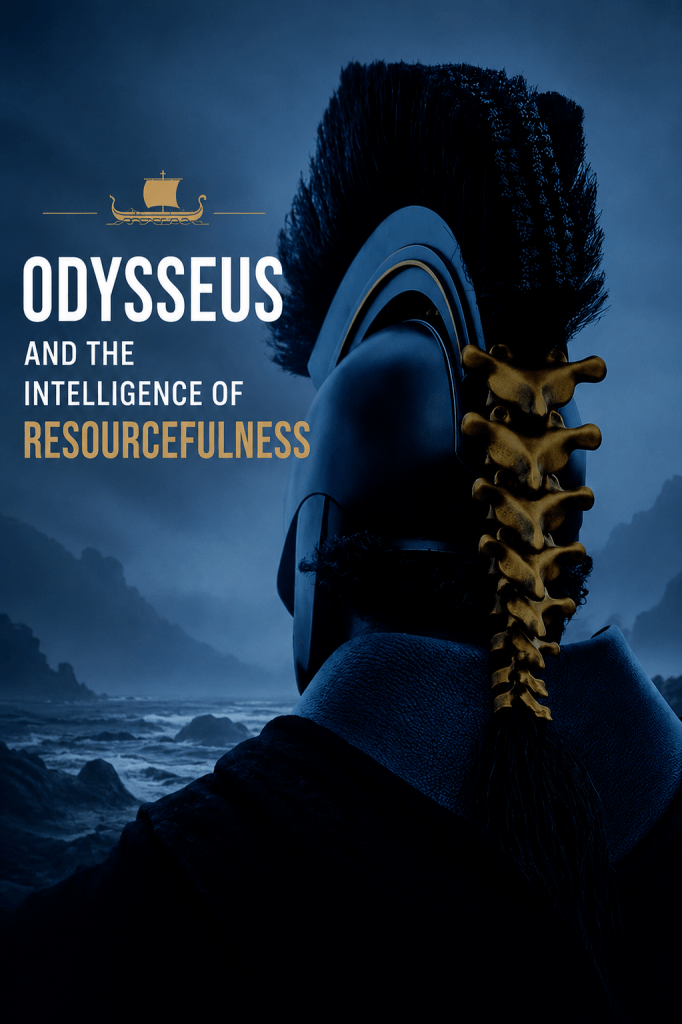
Cunning is often associated with deception, clever tricks, or manipulation. Resourcefulness is something broader. It is a form of practical intelligence—the ability to understand a situation, adapt to changing circumstances, and discover workable solutions when conventional options have disappeared. Throughout the epic, this is precisely what Odysseus does.
Unable to defeat the Cyclops by force, he escapes through invention. Faced with the irresistible song of the Sirens, he refuses the false choice between surrender and avoidance. Instead, he creates a third solution: his companions block their ears while he is tied to the mast, allowing him to hear the song without destroying himself.
At its heart, resourcefulness is the ability to reject false dilemmas. This distinguishes Odysseus from many other epic heroes. Achilles represents physical excellence, courage, and glory in battle. Odysseus represents situational intelligence. His victories are rarely the product of superior strength. They emerge from perception, judgment, timing, adaptation, and imagination.
These qualities extend far beyond mythology. Diplomacy frequently rewards resourcefulness more than power. Negotiation often depends less on imposing one’s will than on discovering possibilities invisible to others. Leadership in uncertain environments rarely follows a manual; it requires interpreting situations for which no established solutions exist.
Perhaps this is one of the reasons why Odysseus still feels so modern. We live in an age where uncertainty has become the norm. Technological change, geopolitical instability, economic disruption, and social complexity constantly create situations for which no ready-made rules exist. In such circumstances, resourcefulness becomes one of the most valuable forms of intelligence.
Nolan’s film also reminds us that Odysseus is not simply a triumphant hero. He is a tragic figure. His intelligence never frees him completely from suffering. Nor is he an isolated individual shaping events entirely through his own will. His fate unfolds within a world governed by forces greater than himself—the gods of Greek mythology continually help, obstruct, reward, and punish him.
In that sense, Odysseus cannot be understood apart from the civilization that created him. He is a product of ancient Greece—its values, beliefs, and imagination. Yet he also transcends his own time. He has become one of humanity’s enduring archetypes: the person who confronts seemingly impossible situations not with superior force, but with ingenuity, judgment, and the determination to find a way forward.
That is precisely why every age rediscovers him differently. Every interpretation of Odysseus reflects the concerns of its own time. Some admire his courage. Others celebrate his cunning. Today, I suspect many of us are drawn to something else: his remarkable capacity to remain effective in a world of uncertainty.
Yet Nolan’s film also reminds us that resourcefulness is not the opposite of tragedy. Odysseus survives not because the world becomes less cruel, but because he continues to adapt to it. His intelligence does not spare him suffering; it enables him to endure it.
Perhaps this is why Odysseus remains so compelling. Shaped by the values of ancient Greece, the rivalries of the gods, and his own strengths and flaws, he continues to challenge every generation to reflect on the limits of human possibility—and on our capacity to discover a way forward when circumstances seem impossible.
Perhaps that is why Odysseus continues his journey—not only across the seas of Homer, but across the imagination of every new age.
#Odysseus #Resourcefulness #Cunning

