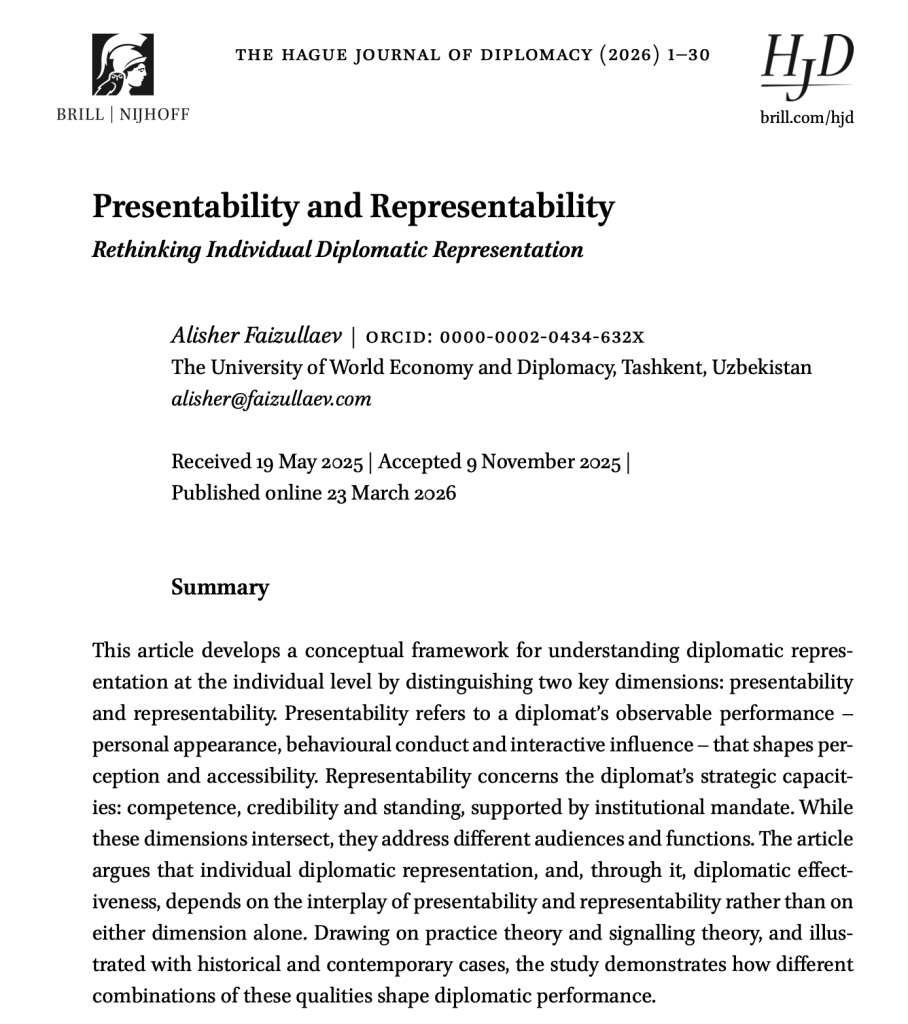
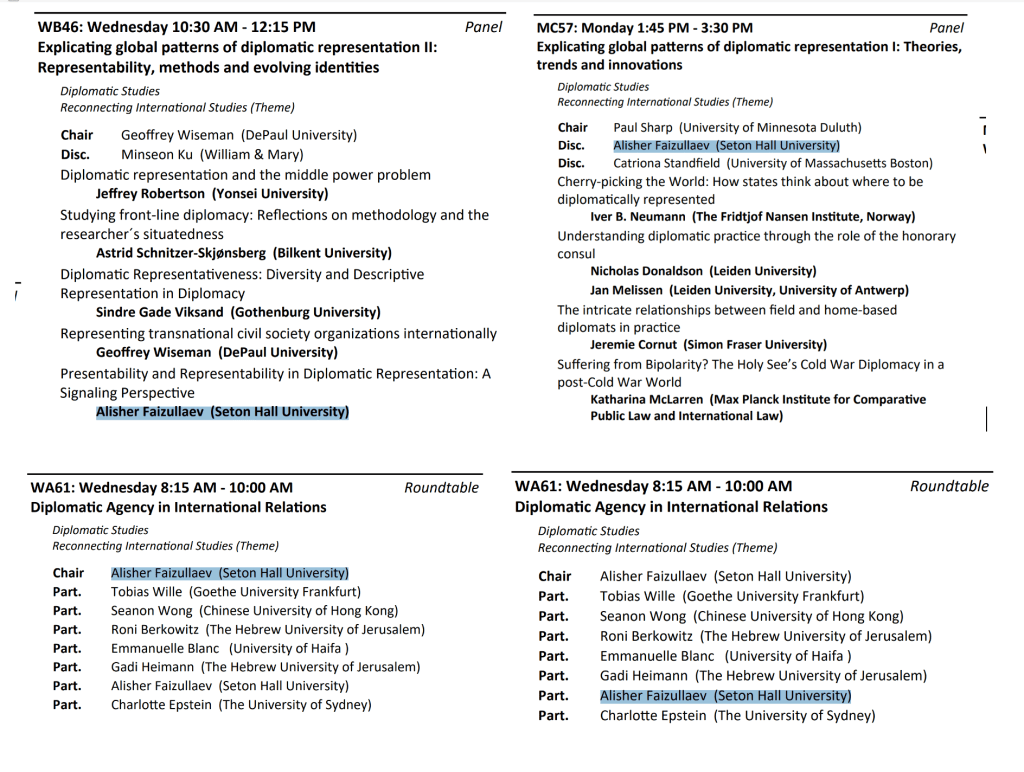
What makes an effective diplomatic representative? We often praise diplomats as “good” or “effective,” but effective in what sense? I have been developing a simple framework for reflecting on two dimensions of individual diplomatic representation: presentability and representability. The framework is intended to help analyse diplomats more systematically and to support diplomatic education, training and professional development.
Here is an early version of such a framework that can be tested in a classroom or training setting.
A FRAMEWORK FOR REFLECTING ON INDIVIDUAL DIPLOMATIC REPRESENTATION
Presentability is a diplomat’s capacity for effective social performance. It concerns how diplomats present themselves through their appearance, behaviour and interaction. It shapes first impressions, accessibility and influence.
Choose a diplomat (historical or contemporary) and reflect on the following dimensions:
□ 2 Fair Generally appropriate but often awkward, inconsistent or ineffective.
□ 3 Good Professional, culturally appropriate and able to establish constructive relationships.
□ 4 Very Good Projects confidence, adapts well across cultures and communicates persuasively.
□ 5 Outstanding Creates exceptional trust, respect and positive engagement across diverse audiences.
Representabilityis a diplomat’s recognized capacity to represent the country credibly and effectively. It combines competence, credibility, judgement and the authority associated with the representative role.
Choose a diplomat (historical or contemporary) and reflect on the following dimensions:
□ 1 Poor Lacks competence, credibility or authority.
□ 2 Fair Has basic competence but limited influence or credibility.
□ 3 Good Competent and generally trusted to represent national interests.
□ 4 Very Good Exercises sound judgement and significant diplomatic influence.
□ 5 Outstanding Represents the country with exceptional authority, credibility and strategic effectiveness.
Presentability concerns the social dimension of diplomacy — how diplomats appear, behave and interact with others. Representability concerns the strategic dimension of diplomacy — how diplomats think, judge and advance their country’s interests. Although the two are closely intertwined in practice, representability ultimately underpins durable diplomatic effectiveness, while presentability shapes access, trust and influence.
The practical refinement of presentability is smoothness — the capacity to conduct social interaction with ease, tact and influence. The practical refinement of representability is smartness — the capacity to exercise strategic judgement with competence, credibility and authority.
How could this framework be improved? Would you find it useful in diplomatic academies, foreign ministries or executive education?
For further reading: Faizullaev, Alisher. (2026). “Presentability and Representability: Rethinking Individual Diplomatic Representation”, The Hague Journal of Diplomacy (advance publication). DOI: https://doi.org/10.1163/1871191X-bja10232
Just returned from the European Negotiation Conference in Paris. It was encouraging to see how negotiation is continuing to grow as a distinctive field of both scholarship and professional practice. The conference brought together researchers, practitioners, consultants, coaches, diplomats, business professionals, and AI experts from many countries — a reflection of the field’s increasing diversity and vitality.
I was especially struck by the growing number of executive education and practice-oriented workshops. As organizations face more complex and uncertain environments, the demand for advanced negotiation capabilities is clearly increasing.
Many discussions also touched on the fragility of the current world order and on how negotiation, despite all its limitations, can help move us toward greater mutual understanding and peace. Artificial intelligence was another major theme throughout the conference.
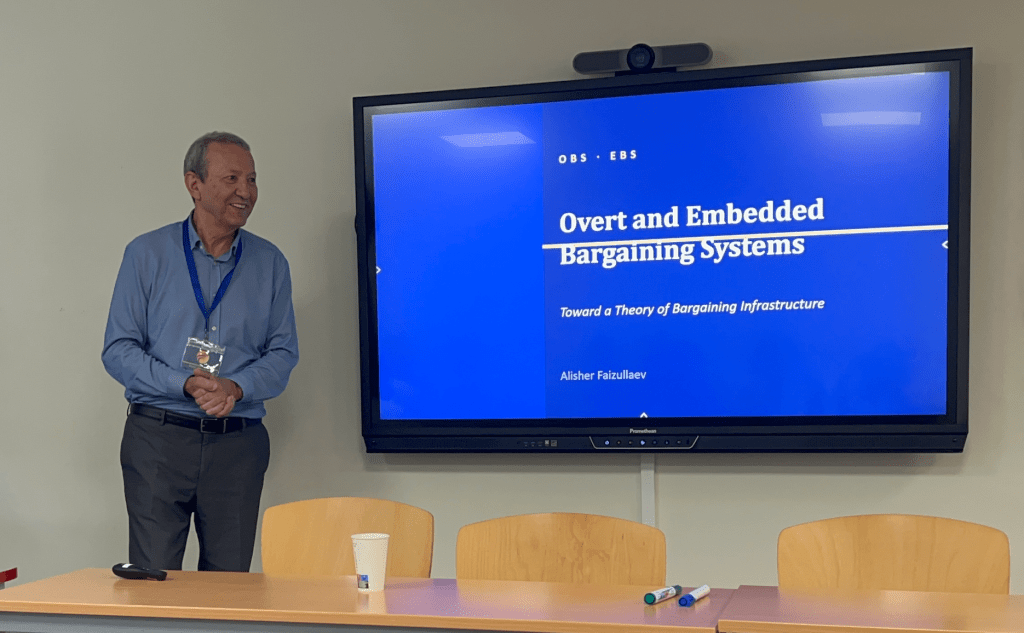
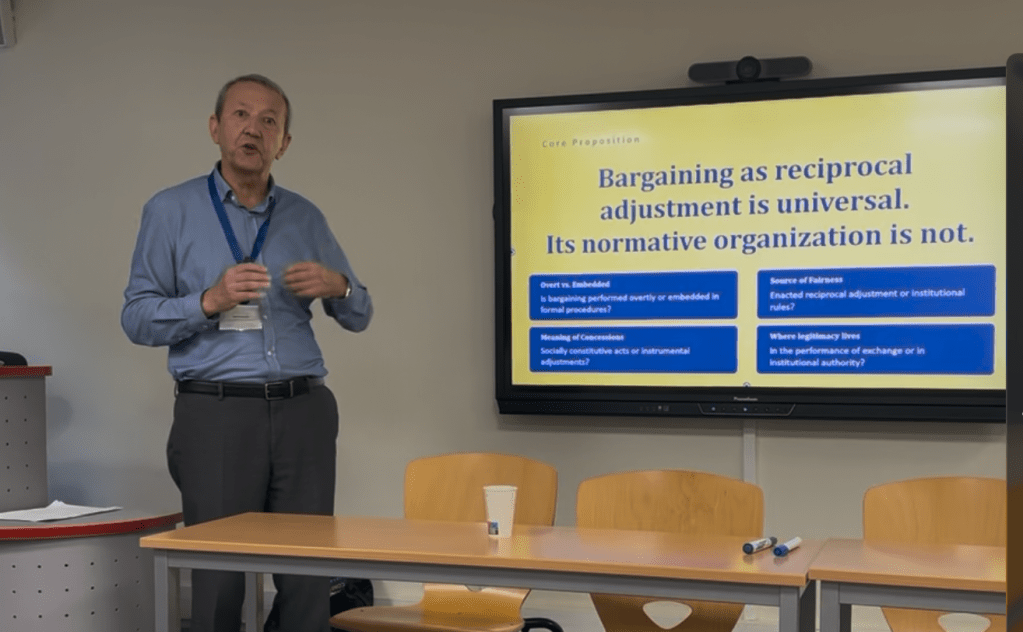
I was pleased to present my paper, “Overt and Embedded Bargaining Systems: Bargaining Infrastructure and the Organization of Reciprocal Adjustment,” and to exchange ideas with colleagues from around the world.
The conference left me optimistic. Negotiation studies are becoming an increasingly vibrant interdisciplinary community, and I look forward to seeing where the field goes next.
Watching major football tournaments has made me think about something that extends far beyond sport. At the highest level, success is rarely produced by individual talent alone. It depends on infrastructure.
A world-class football team requires youth academies, experienced coaches, strong domestic leagues, sports science, financial resources, international exposure, and regular competition against elite opponents. The same is true in academia.
World-class research depends on much more than brilliant scholars. It requires libraries, seminars, conferences, research funding, doctoral training, international networks, rigorous criticism, access to journals, and institutions that make excellence routine rather than exceptional.
Of course, exceptional individuals sometimes emerge despite weak infrastructures. History offers many examples. Yet sustained excellence—whether in sport, science, or the arts—is rarely achieved in this way.
There is, however, an important nuance. Infrastructure does not have to be domestic. Many outstanding footballers come from countries with relatively weak football systems but reach their full potential after entering the academies and clubs of Europe’s leading leagues. The same is true in academia. Talented researchers may begin their careers in modest universities yet flourish after joining stronger international research environments. What matters is not only where talent originates, but whether there are pathways connecting talent to infrastructures capable of developing and recognizing it.
Infrastructure also performs another, less discussed function. It does not merely produce excellence; it regulates access to excellence. Strong infrastructures cultivate talent, but they also influence who is admitted, trusted, recognized, funded, and given opportunities to grow.
Perhaps this offers another perspective on the long-standing structure–agency debate. Agency helps explain exceptional individuals. Infrastructure helps explain why exceptional individuals emerge repeatedly in some environments and only rarely in others.
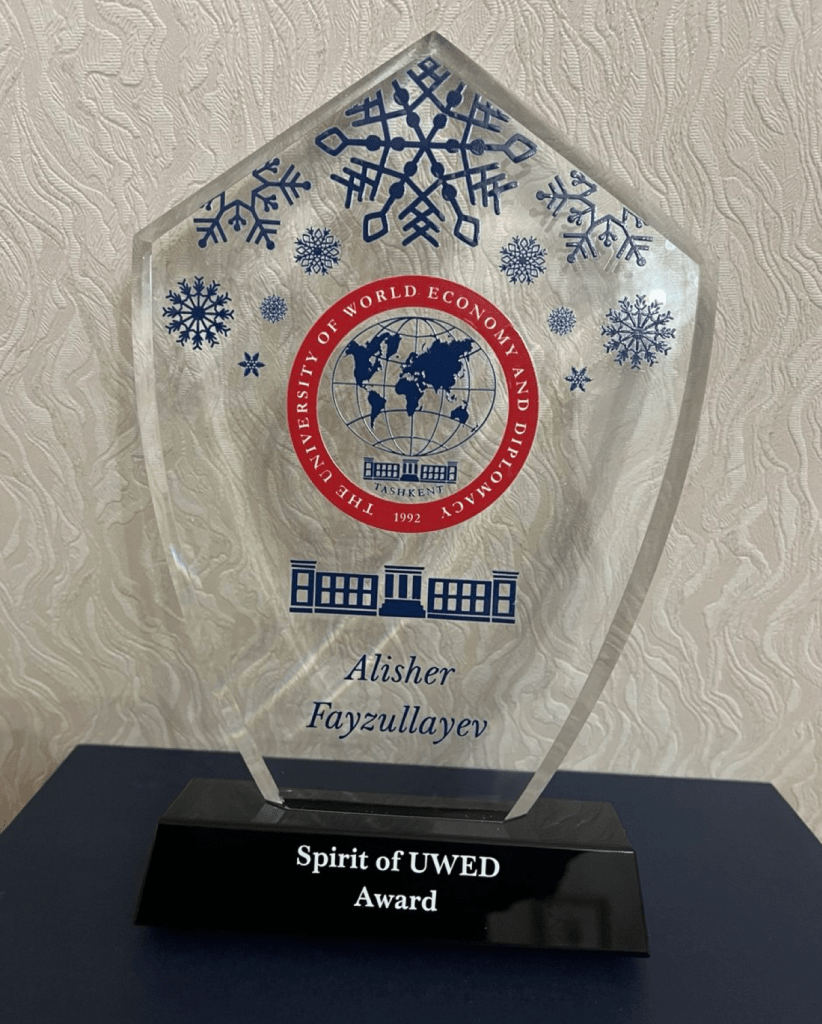
I am deeply grateful to my university, the University of World Economy and Diplomacy, and personally to Rector – Senator Sodyq Solikhovich Safoev for the Spirit of UWED Award.
It is a great honor to teach at UWED, one of the leading universities in Central Asia, and to work with such talented students and colleagues.
Fencing and negotiation may seem worlds apart – one takes place on a piste with blades, the other across a table with words. Yet both belong to the same ancient art: the art of strategic interaction.
As a former fencing athlete – Master of Sports and member of Uzbekistan’s junior team (foil) – and ex-ambassador, I have long felt how movement, timing, and awareness shape not only competition but also negotiation and diplomacy. In both fencing and negotiation, every move matters. You face an opponent who is, paradoxically, also your partner in creating the outcome. You win not by overpowering, but by reading, anticipating, and harmonizing with the rhythm of the encounter. And in diplomacy and negotiation, like in fencing, real emotions can be hidden behind the masks. I use negotiation for the universal craft and diplomacy for its grandest stage –statecraft – but the blade and the mask work the same in both.
In fencing the mask is literal – steel mesh that turns the face into a blank oval, forcing both combatants to read shoulders, hips, the tremor of a wrist. Yet it is never neutral: it magnifies micro-signals while shielding the eyes that might betray fear or triumph. The diplomat’s mask is subtler – posture, tone, the calibrated half-smile – yet it serves the same double purpose. It protects vulnerability and projects control. Skilled practitioners learn to inhabit the mask without letting it ossify. A fencer who freezes behind the grille is stabbed; a negotiator who mistakes his persona for his person concedes the agenda. The master, therefore, treats the mask as a mirror held at arm’s length: it reflects the opponent’s expectations back at them, distorted just enough to create openings. When to lower it – briefly, strategically – becomes the final feint. A flash of genuine frustration can lure an overconfident lunge; a flicker of empathy can coax the concession neither side thought possible. The mask, then, is less disguise than instrument: played well, it reveals more than it conceals.
Every fencer knows that victory depends less on strength and more on timing, distance, and clarity of intention. One has to read or assess the situation as a whole. The same is true for negotiators. The best negotiators, like skilled fencers, sense when to advance, when to pause, and when to let the other side make their move first. They know how to disguise intent without losing authenticity and how to stay calm amid uncertainty.
The art of anticipation lies at the heart of both disciplines. In fencing, you learn to read your opponent’s body before they move – a subtle shift in weight, a fraction of tension, the rhythm of breathing. You do not simply react; you position yourself where their next move will leave them vulnerable. You need to think several steps ahead.
In negotiation and diplomacy, the same principle applies. The skilled diplomat reads not just words but silences – the pauses that reveal doubt, the emphases that betray priority. Anticipation is not prediction; it is awareness so sharp that you move with events, not behind them. You create space for outcomes before others realize they are possible.
In game theory, Thomas Schelling described a “strategic move” as an action designed to shape another player’s expectations and choices. Both fencing and negotiation embody this principle. The expert fencer and the seasoned diplomat know that a move is never just a movement – it is a message. It signals, provokes, and reshapes the situation. The most decisive move often appears indirect: a feint, a pause, an invitation that makes the other commit first.
Both disciplines are simultaneous games – players act concurrently, ahead of, or in reaction to one another. This makes the game harder, yes, but infinitely richer in strategic possibility. In fencing, you cannot wait for your opponent to fully extend before responding – but you can invite the extension with a half-step back, a flicker of the blade. Negotiation follows the same logic: you don’t counter an offer you haven’t heard, but you can shape the silence – a pause, a raised eyebrow, a question left hanging – until the other side feels compelled to speak first.
In both games – whether with swords or with mental strategies – the mastery lies not in aggression but in presence, timing, and design. Each move expresses intention, communicates possibility, and defines the space of mutual understanding. However, the move can also be deceptive, and the best fencers and negotiators can distinguish the real one from the deceptive.
One might argue that many sports involve strategy, reading opponents, and tactical thinking. Yet fencing occupies a unique position. Unlike tennis, where the court separates and faces are visible, fencing occurs at conversational distance – close enough to read breath and tremor, masked enough to require interpretive skill. Unlike sports where reaction time eclipses strategic thought, fencing’s tempo allows for the pregnant pause, the deliberate invitation, the calibrated feint. And unlike games where implements mediate contact, the blade is direct extension of intention, a communicative instrument that signals as it threatens. Fencing, like diplomacy, emerged from the same crucible: the aristocratic culture of honor, where negotiations failed and swords spoke. They are not merely analogous – they are cousins.
Diplomats sometimes say that negotiations are “fencing with words.” Fencing, at its best, is a dialogue of minds expressed through movement. Both arts remind us that the finest victories are those achieved not only with strategy, precision, and timing, but also with grace. And perhaps this is the deepest parallel: in both fencing and negotiation, the bout ends but the relationship continues. The opponent you face today may be your partner tomorrow. The fencer who scores with brutal efficiency may win the point but lose the respect that shapes future matches. The diplomat who extracts maximum advantage may secure the agreement but poison the well for what comes next. True mastery, then, lies not merely in winning but in winning in a way that preserves the possibility of future engagement – fighting as if you might one day need to fight beside your opponent, negotiating as if today’s adversary might become tomorrow’s ally. This is why grace matters: it is not ornament but insurance, not weakness but wisdom. The mask comes off, the blades are lowered, and what remains is the memory of how you moved – and whether, when next you meet, the other side will trust you enough to engage again.
Throughout my fairly long life, I may have met one or two truly talented people (and even then, I’m not entirely sure). There are, of course, more capable individuals. But ability, unlike talent, is not necessarily an inborn trait—it can also be the result of effort, experience, and discipline. Talent, on the other hand, is something natural, innate, independent of effort. You either have it, or you don’t.
I believe that much of the talk about talent is heavily mythologized. Truly talented people are extremely rare (and geniuses are even rarer). The vast majority of successful individuals achieve their status not due to some inherent gift but primarily through hard work, perseverance, and, to some extent, luck.
So, talent may not be entirely a bad thing, but you’ll still have to work. And work damn hard if you want to achieve anything on this planet (ah, motivation, motivation!). A bit less if you have abilities, but even they don’t mean much on their own—you need to know how to apply, develop, and even retain them; otherwise, they quickly fade away. In short, if there’s no talent, there’s always hard work and sweat.
By the way, this is something to be glad about: if your success is based entirely—or even mostly—on talent, then there’s little personal merit in it. After all, talent is given to you from the outside, and you possess it not because of your own efforts or achievements. There’s little sense in relying on a gift that was handed to you by chance.
A new video on the Diplomatic Nexus YouTube channel: my conversation with Dr. Jozef Bátora about the European Union’s diplomacy, the organization and the functioning of the EU diplomatic service. Dr. Bátora is a Professor of International Relations at Webster Vienna Private University in Vienna and at the Department of Political Science, Comenius University in Bratislava. He was also a senior researcher at ARENA Centre for European Studies, University of Oslo, researcher at the Austrian Academy of Sciences in Vienna, and visiting scholar and visiting professor at Stanford University.
I recommend it to anyone interested in the EU and European diplomacy.
Some people combine intellectual humility with emotional rebellion, while others pair emotional humility with intellectual rebellion. These states seem to balance each other out. When emotional and intellectual humility coincide, an internal, “underground” revolution of consciousness occurs. And when emotional and intellectual rebellion resonate together, an evident, “above-ground” transformation of the individual and society emerges, changing the world.